|
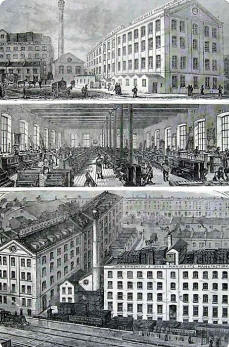


UNE GRANDE MANUFACTURE DE
PIANOS À LONDRES
 "
" ENTRE
autres raisons qui font que la musique est un art à part et qu'elle doit
occuper une place absolument spéciale, il y a celle-ci: tandis que, dans les
autres arts, et notamment dans les arts du dessin, l'instrument est un
accessoire insignifiant, 1 âme de 1 artiste passant tout entière au bout de
ses doigts, qu'ils tiennent un pinceau, un crayon, une plume ou un burin, la
musique exige toujours l'intervention de deux hommes (sans compter le
compositeur), et demande, pour l'exécution, l'accord de deux âmes, celle de
l'exécutant et celle du facteur.
Ah! nous savons bien, en écrivant ces lignes, ce qu'on nous objectera : on
prétendra que nous mettons sur la même ligne deux ordres de mérites très
inégaux ; que nous confondons dans un même éloge le génie artistique et la
simple habileté industrielle !
Mais nous protestons de toutes nos forces contre une pareille appréciation
du rôle du facteur d'instruments, et s'il est malheureusement vrai que
certains facteurs envisagent leur rôle comme un simple métier, il en est
d'autres qui ont une conception plus haute et plus vraie de leur art, qui
sentent, comme tous les artistes dignes de ce nom, dans une exécution
musicale, deux parts entièrement distinctes : le sentiment, l'enthousiasme,
l'inspiration, qui sont le lot de l'artiste ; l'ampleur, la majesté, la
douceur des sons, qui appartiennent au facteur, et si l'on nous soutient
qu'il n'y a pas une part d'âme dans la sonorité, nous demanderons à nos
adversaires s'il n'y a pas d'âme dans le murmure des bois, dans le
grondement des flots, dans le roulement du tonnerre.
Pour tout concilier, nous accorderons qu'il existe deux types distincts de
facteurs d'instruments de musique : ceux qui comprennent toutes les poésies
du son et ceux qui ne savent que découper le bois et limer le fer ; que
chacun choisisse entre les deux types ; quant à nous, nous ne voulons
admettre que le premier,et c'est parce que M.Edgar Brinsmead, de Londres, de
la maison John Brinsmead et fils, appartient très nettement à ce type, que
nous avons résolu de présenter cette grande maison à nos lecteurs.
Nous connaissons, pour tout dire, d'autres facteurs de pianos épris de leur
art ; nous n'en avons jamais connu qui l'aient étudié avec autant de
passion, car lui seul, à notre connaissance, a apporté dans cette étude le
zèle parient des archéologues et cherché les origines du piano-forte (comme
disent les Anglais) jusque sur les monuments cryptographiques des Assyriens
et des Egyptiens, comme il l'a fait dans la belle histoire du piano (History
of the piano forte) que nous avons actuellement sous les yeux.
Nous avouons, toutefois, que ce travail d'érudit ne recommanderait; pas
suffisamment la maison de Wigmore Street, 18, (London W) à son immense
clientèle internationale ; qu'il a fallu encore, pour lui concilier les
suffrages du monde entier, pour lui mériter des grandes médailles d'or, des
diplômes d'honneur, des récompenses de premier ordre à Londres (1862), à
Amsterdam (1869), à Philadelphie (1876), à Paris (1867, 1874, 1878), etc.,
etc., partout enfin où elle a affronté la concurrence des plus grandes
maisons du monde dans sa spécialité, il lui a fallu, disons-nous, autre
chose que la connaissance des évolutions historiques des instruments à
cordes, elle a dû se mettre à la tête du progrès, dans cette magnifique
transformation à laquelle nous avons tous assisté, et qui a fait du piano le
vrai roi des instruments.
Il lui a Jallu, depuis la fondation de ces magnifiques ateliers de Grafton
road, 18, qui occupent une étendue superficielle de 62.675 pieds anglais et
655.866 pieds cubes et viennent de s'accroître de ceux de Charles Street
Fitz-Roy Square qui font, depuis quelques jours seulement, l'admiration de
Londres tout entier, il lui a fallu multiplier sans trêve ni cesse les
améliorations des anciens types d'instruments, accumuler les brevets en
1862, 1868, 1871, 1875, etc., forcer l'approbation enthousiaste des
pianistes du monde entier, et rester, au milieu de l'approbation
universelle, seul mécontent de ce qu'il avait fait.
Tel fut John Brinsmead, qui s'établit en 1836, tels sont ses fils Thomas et
Edgar, qu'il aformés à son image et dont il a fait ses collaborateurs, tous
moins occupés à admirer leurs œuvres qu'à y découvrir des défauts et des
lacunes, pour trouver une occasion, se fournir un prétexte de. combler
celles-ci et de corriger ceux-là.
Le chef de cette très honorable maison n'est plus jeune aujourd'hui ; il ne
s'en fait pas moins une sorte de point d'honneur d'imiter l'activité que
déployait son père à l'époque où, venu du Devonshire à Londres (il y a de
cela quarante-six ans), il fondait son premier, son très modeste atelier,
où, à la tête d'un petit nombre d'ouvriers, il jetait les premières bases de
cette réputation aujourd'hui incomparable.
Aujourd'hui, en effet, la maison Brinsmead et fils occupe une véritable
armée d'ouvriers émérites, sévèrement classés par spécialités, d'après le
grand et fécond principe de la division du travail, et exécutant ainsi
jusqu'à trente opérations distinctes confiées à des groupes distincts.
Elle produit généralement de 300 à 400 instruments à la fois, et emploie,
par an, environ pour 500,000 francs de bois exotiques à la construction de
deux à trois mille pianos.
Nous nous abstiendrons de décrire et même de mentionner ici soit les
inventions de la maison Brinsmead, soit les nombreux types d'instruments
qu'elle construit, et ce pour cette raison décisive que l'indication des
améliorations apportées à la mécanique, à la table d'harmonie, à la pédale
supplémentaire destinée à assurer la tenue des sons, etc., etc. ne saurait
ni intéresser les artistes qui ont eu le bonheur de promener leurs doigts
sur les touches du Grand Concert, ni instruire sur la valeur de ce
magnifique instrument les artistes (s'il en est) à qui il n'a pas encore été
donné de l'entendre.
Nous ne sommes pas, heureusement pour nous, de ces déshérités de l'art
musical, et c'est pourquoi l'harmonie vraiment céleste des instruments de la
grande maison londonienne résonne encore dans nos oreilles, depuis le jour,
lointain déjà, où nous les avons entendus pour la première fois. - R."
Le
Panthéon de l'industrie : journal hebdomadaire illustré, 1883, p. 396-398
(gallica.bnf.fr)


 VUE DE LA MANUFACTURE DE PIANOS DE BRINSMEAD ET FILS,
A
LONDRES, N. W. ,
Le Panthéon de l'industrie :
journal hebdomadaire
illustré, 1883, p. 397 (gallica.bnf.fr)
BRINSMEAD
on this site
Click on the links above.
For references see page
alfabetic B

© Copyright all rights reserved
|
