home
| Pianoforte-makers
in England
BRINSMEAD
in London

1893
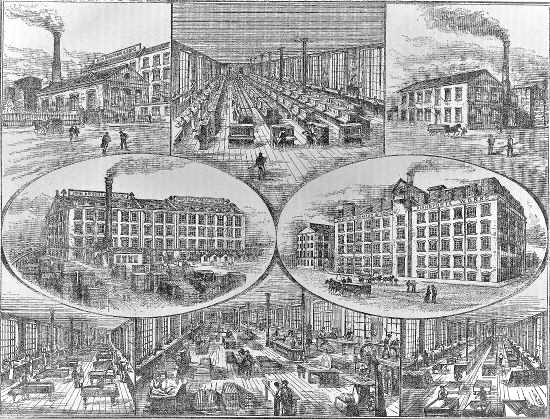
The record of any of the leading business houses of Great Britain invariably discloses a story of remarkable success from small beginnings to a triumphal development, and in this respect the career of the eminent pianoforte-making firm of Messrs. John Brinsmead & Sons furnishes one of the most interesting examples of enterprise which the history of London trade and industry contains. The house originated in the reign of King William IV. in a shop in Charlotte Street , Fitzroy Square, long since abandoned. There Mr. Brinsmead first opened, with the assistance of two men and an apprentice, until subsequent expansion suggested the acquisition of a factory at Tottenham Court Road, which afterwards gave place to the great block of buildings at Kentish Town that now comprehend the industrial labours of the firm and their staff of 300 skilled men. Every year from the first has marked a series of enlargements, improvements, and innovations, that exemplify the tireless and energetic manner in which Messrs. Brinsmead have endeavoured to bring to perfection the all-important industry with which their name has a world-wide association. The Brinsmead Works at Kentish Town represent the culmination of the firm’s successive trials towards perfect organisation and equipment; and to anyone who is permitted to survey the interiors of the several buildings, the scrupulous methods which the firm employ, the satisfactory and minute sub-divisions of labour, and the extreme orderliness and expertness with which the merest details are forwarded, it will be manifest that Messrs. Brinsmead have spared nothing towards sustaining their well-won distinction in this branch of work, nor have omitted anything which modern ingenuity and their own experience could suggest to render complete a factory which, while conducted with the above staff, boasts an installation of sound plant, possessing sufficient power to maintain the firm’s remarkable yearly output of nearly 2,000 pianos per annum. Of the factory and its ample accessories, all of which present a forcible contrast with the unpretentious shop in which Messrs. Brinsmead’s great industry was initiated, the new factory is perhaps the most noteworthy feature, and it is here that the progress of the house is particularly manifested. The manager of the works is himself one of the Brinsmead family, while the senior partner of the firm has in no degree relaxed that enthusiastic interest in the advancement of piano production, which has been the basis of the firm’s almost unparalleled renown, and has made the name of Brinsmead — in every sense — a very household word. It would take a special opuscule on piano manufacture to enumerate even some of the various processes that this industry involves, and this being beyond the scope and purview of the present concise report on the firm’s position in relation to the work they exemplify, it may be more in accordance with the object of our present work to here direct particular attention to the firm’s saloons in Wigmore Street, wherein the highest and best phases of modern piano manufacture are illustrated under all the conditions characteristic of the principal west-end establishments. The Wigmore Street premises are indeed one of the “sights” of fashionable London, and have few rivals as regards their general attractiveness, while they are absolutely unsurpassed in respect alike of the great variety of pianos exhibited, and the magnificent quality and superb workmanship these embody.
The entire series of six showrooms are replete with instruments
exclusively of the firm’s own manufacture, and these number some 300 or 400,
ranging in price from the sound and popular drawing-room piano at forty
guineas to the most exquisite and elaborately finished model at the
plutocratic cost of three hundred and fifty guineas. The almost numberless
expressions of approval that have come unsolicited to the firm from the
English and Scottish press, from personages of rank and distinction, as well
as from the most accomplished virtuosi of the day, render unnecessary any
lengthy review in this short sketch of the unchallenged merits of Messrs.
Brinsmead’s pianos. Mr. Edgar Brinsmead is the author of a “History of the Piano,” which has become recognised as authoritative on the subject, while Mr. Thomas Brinsmead has had a life-long association with all the practical features of piano manufacture under the guidance of his father, the venerable and esteemed founder of the firm; and the prize medals and distinctions gained at home and abroad by the house have over and over again confirmed the truth of that famous utterance of the great Rubinstein — “the palm belongs to the grand pianos of the house of Brinsmead.” It need only be said in conclusion that to this honoured house belongs a very considerable share of the credit which the English-made piano of to-day so satisfactorily preserves. The highest authorities in the land — professional and otherwise — might be liberally quoted as corroborative of the fact that the productions of this firm rank foremost in general estimation; but the same object maybe attained if we refer merely to the Messrs. Brinsmead’s ever-increasing volume of home and export trade, and to the commercial laurels which more than half a century’s successful work, and the universal testimony of an appreciative public, have tended to confer." Ilustrated London and its representatives of Commerce, 1893 (messybeast.com)
1894
MESSRS. BRINSMEAD'S NEW PREMISES.
The new show-rooms occupy the ground floor and basement of a commanding building of four stories above the ground floor, treated in the style of architecture prevalent in England in the sixteenth century, with projecting oriels and stone mullioned windows, a pleasing sky line being produced by the form of the gables. A large lobby is situated in the centre of the front, from which one enters the show-rooms, nine in number, on the ground floor, the first two being devoted to grands, the remainder to upright instruments. On this floor also are the offices and a waiting-room. The object has been to provide many rooms capable of contain ing about ten pianofortes each, rather than larger rooms with more instruments, in order that several customers may be suiting their tastes at one time without interfering with each other, and also that the work of the tuners may proceed without hindrance. A handsome staircase leads to the basement, where is situated a music room, tastefully decorated with tiles and mirrors, and fitted with stalls for an audience of 133 persons. The remainder of the basement is devoted to show-rooms, similar to the floor above. The arrangements for the receipt and discharge of goods have also been well thought out, with a view to avoid the inconvenience to customers of meeting the porters with their heavy loads. When an instrument arrives from the factory it is placed on a lift outside the building, in the forecourt, in Wigmore Street, and from there descends to the basement. Then (if required) it is placed on another lift and taken to the centre of the ground floor, and thence removed to the room alloted to it, according to the style of the piano. The whole of the panelling which forms the divisions of the several show-rooms is in sequoia wood, french polished, and was executed by the firm in their factory, the Brinsmead Works, Grafton Road, Kentish Town. Altogether about 20 grands and 100 uprights can be shown to advantage in the firm's new premises. L. J. Sharp, Birmingham, Official Receiver. The building was designed by Mr. Leonard V. Hunt, A.R.I.B.A., and erected under his per sonal supervision by Messrs. Holloway Brothers, Battersea." Music Trades Review, 15/05/1894, p. 31-33
CONCERNING A PRINTER'S ERROR.
To the Editor of THE
ARTIST. "Judged by the standard of antiquity of so many other musical instruments-for the pianoforte can be a musical instrument as well as an indispensable article of furniture-the pianoforte belongs but to yesterday. No one further back than Signor Cristoforo, of Padua, in 1710, or our own Father Smith a year later, thought of this instrument seriously, and we doubt very much whether the really practical combination of talents was found in this art trade before the young Scotch carpenter came to London in 1751 and married the daughter of Trehudi, the great harpsichord maker, and founded the firm of Brinsmead." This statement is
entirely unfounded, and may mislead the public by inducing the belief that
the and general art work history relating to the foundation of the firm of
John Broadwood and Sons relates to the foundation of the firm of Brinsmead. "In the year 1751, John Broadwood, a young Scotch carpenter and joiner, about twenty years of age, arrived in London, and succeeded in obtaining a situation in the employ of Tschudi, where he rapidly rose into favour with Mr. and Miss Tschudi. Like the proverbially good apprentice, he married his master's daughter, and became his partner and successor. In 1776, Becker, or Backers, assisted by John Broadwood, and another workman in the employment of Tschudi, Robert Stodart, after many experiments, succeeded in producing the grand action which was used by Stodart until the time of the dissolution of the celebrated firm founded by him. This mechanism has been used by the firm of John Broadwood and Sons, with slight modifications, until the present time. The first mention of a grand pianoforte, made with this action, is found. in the books of Tschudi and Company, under date 1781." It is untrue that the firm referred to by your contributor was founded in 1751 by the young Scotchman who married Miss Tschudi, not Trehudi, as mis-spelt by the writer of the article referred to. We hope that you will
consider that, in common fairness, and as a matter of justice to ourselves,
we are entitled to ask that the mis-statement should be corrected by your
inserting a copy of this letter in your next issue [We much regret the mistake, which was entirely our own oversight. Messrs. Brinsmead have also written to us to correct the printer's error. The series of articles commenced last month on this important question of modern furnishing will be continued in the next issue.--ED.]" The Artist, 11/1894, p. 424-425
1896 IMPORTANT NOTICE AND CAUTION
The vendors fixed the price of the goodwill of the business which they were selling to the company at £76,000, and the goodwill carried with it the exclusive right to use the name of T. E. BRINSMEAD & SONS. But no sooner was the company started than it was attacked by the original firm of JOHN BRINSMEAD & SONS, and an injunction was granted by NORTH, J., and confirmed by the Court of Appeal, restraining the company from using the name of BRINSMEAD without adding an express statement that it had Towards the close of the year 1892 a strong demand was no connection with the original firm. In these proceedings it was held that the design of the promoters of the company was to get as much as they could of JOHN BRINSMEAD & SONS' business by the use of the family name, and that the £76,000 charged for goodwill was really charged for the improper advantage it was hoped to obtain. Of the purchase price a considerable part seems to have actually passed into the hands of the vendors. Under these circumstances it was alleged that the company ought to be wound up under the "just and equitable" clause. The company, it was said, was based on fraud, and by reason of the injunction the substratum of its business was gone. But the mere fact that there has been fraud in the formation of a company is not a sufficient ground for winding it up. The shareholders may think it most for their interest to waive the fraud and carry on business on the best terms they can (Re Haven Gold Mining Co., 20 Ch. D. 151), and, although in the present case the company may have been greatly prejudiced by the injunction it appeared that it had by no means lost its business. The substratum of the business was not gone in the same manner as in the cases in which upon this ground a winding-up order has been made-where, for instance, a title to the property sold to the company cannot be made out (Re Haven Gold Mining Co., supra), or a patent on which the business depends cannot be obtained (Re German Date Coffee Co., 20 Ch. D. 169). But though the whole substratum of the business was not gone, VAUGHAN WILLIAMS, J., held that the disappearance of a substantial part of it gave him a discretion to make a winding-up order, and notwithstanding that a considerable business remained and that there were shareholders who desired to carry it on, he exercised his discretion in favour of a windingup. In his decision he seems to have been largely influenced by the facilities which the winding-up procedure would afford for the recovery of any money which might have been improperly paid to the vendors." The Solicitors' Journal, 19/12/1896, p. 123
1897
The firm of John Brinsmead & Sons largely owes its success to the specialties that have been patented by it during the past 35 years, that is to say, the pianoforte mechanism known as the perfect check repeater action, the castanet sounding board, the sound board compensator, the new string adjustment and complete metal frame, the tone sustaining pedal, the string compensator, and numerous other improvements that have quite revolutionized the English pianoforte. These specialties have been advertised at the International Exhibitions of London, Paris, Philadelphia, Amsterdam, Brussells, Sydney, Melbourne, Adelaide, Calcutta, South Africa, Dunedin, Hobart, Brisbane, Jamaica, Barcelona, Western Australia, Antwerp, Naples, Cork, Edinburgh.
The numerous gold medals that have been
gained by the firm are the best advertisements that have ever fallen to
the lot of John Brinsmead & Sons, and the fact that Mr. John Brinsmead
was decorated with the Legion of Honor of France, and also with the
ribbon of the Royal Portugal Order of Villa Vicoza, made the Brinsmead
pianos increase in popularity by leaps and bounds.
The publicity given to the first class
medals that were awarded the firm rapidly developed it, till its name
became a household word in Great Britain and the Colonies.
1910
When he first entered the service of the famous house, its destinies were under the active control of Mr. John Brinsmead the founder (who was then but fifty-nine), the managerial responsibilities being shared by the two partners Mr. Thomas John Brinsmead (then twenty-nine years of age) and Mr. Edgar Brinsmead (who was only twenty-three). Mr. Burbidge has survived them all. He remembers the house of Brinsmead as the only piano house in Wigmore Street: this was in the early seventies. Mr. Burbidge carries with him the hearty good wishes of those who have served with him no less than of those whom he has served. He takes into his well earned leisure seven and thirty years of recollection,- years crowded with interesting associations and enriched with pleasant memories. May he long enjoy them !" Musical Opinion and Music Trade Review, 09/1910, p. 873
BRINSMEAD
Click on the links above.
For references see page
|
|||||||||||