|
 Pianoforte
for Peninsular and oriental steamship Paramatta,
1851 (?) Pianoforte
for Peninsular and oriental steamship Paramatta,
1851 (?)

 LONDON -
"474
Brinsmead, J. 15 Charlotte St. Fitzroy Sq. Manu. —Registered pianoforte,
with improved joint."
Official catalogue, Great exhibition, 1851,
p. 70 LONDON -
"474
Brinsmead, J. 15 Charlotte St. Fitzroy Sq. Manu. —Registered pianoforte,
with improved joint."
Official catalogue, Great exhibition, 1851,
p. 70
LONDON -
"474
Brinsmead, J., Fab., 15 Charlotte Street, Fitzroy Square. – Ein Pianoforte."
Amtlicher Catalog der Ausstellung der
Industrie-Erzeugnisse aller Völker, 1851, p. 66
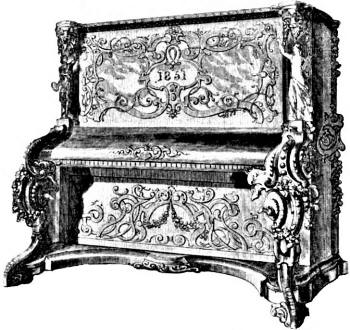
Registered
Pianoforte on the London Exhibition of 1851,
Official description and illustrated catalogue of the
Great exhibition, 1851, p. 465
LONDON -
"474
Brinsmead, John, 15, Charlotte Street, Fitzroy Square - Manufacturer.
Registered pianoforte - the long brass joint generally seen upon the
fall of pianofortes, obviated when opening by a simple contrivance. The
case permits the instrument to be placed in any part of a room.
Embroidered device in the central panel, and music stool. [This
instrument is the first instrument in the left border]."
Official description and illustrated catalogue of
the Great exhibition, 1851, p. 464-465


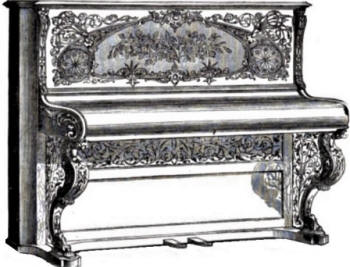
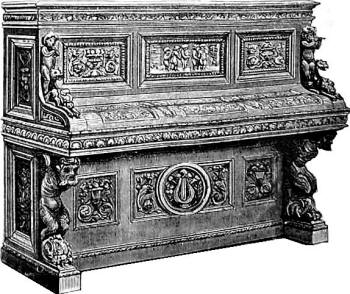
Piccolo Piano in carved case,
Exhibition London, 1862,
Cassell's Illustrated Exhibitor: Containing about
Three Hundred, 1862, p. 103
LONDON -
"In our first illustration we have the
pianoforte exhibited by John Brinsmead, of 15, Charlotte Street, Fitzroy
Square; with model of the action, and so much needed by the profession,
and conveying from the performer to the hammer acting on the string all
the delicacy of action of the finger expressing the feeling of the
player, from the most powerful to the softest quality of tone.
ln the
escapement of this action, the hammer relieves itself from a block on
the end of the key; the set-off and repeat being attained by one
movement. Thus, the touch of the most rapid performer never fails to
elicit a distinct note.
Again, the lever and hopper being superseded in
the mechanism of this action, the full force of the blow is transmitted
direct from the string to the hammer; while, in the ordinary action, the
sticker is hinged from the butt with leather,and connected with levers
by leather clothing, the underside of the lever having a piece of box
cloth, which forms an clastic cushion for the hopper to strike against.
From the consequent and necessary interposition of these clothings, a
portion of the power of the blow is absorbed; while, in this action, the
sticker is connected with the butt by a bushed centre, resting on the
adjusting block and the end of the key, and is the only medium from the
hammer, thus gaining its superiority of power.
In the construction of
the ease, iron supports aro scientifically introduced in front of
bracings, forming square abutments against metal plates from the bottom
block, and bent side to the wrest or tuning-pins' plank, thereby
rendering it impossible for the case to yield to the great pull of the
string; carrying out a perfect compensating principle, and ensuring the
instrument standing to one pitch, however variable the temperature of
climate; as the iron supports in the front of the wood bracings and the
strings contract or expand in the same proportion.
Thus, we have in this
instrument all the modern improvements combined with the principle
patented by Mr. Brinsmead."
Cassell's Illustrated Exhibitor: Containing about
Three Hundred, 1862, p. 103
LONDON - "3370 Brinsmead, J. 15,
Charlotte-st. Fitzroy-sq. — Perfect check repeating grand and upright
piano on a new principle, and models.
3371 Brinsmead, J. 15, Charlotte-st. Fitzroy-sq. — Tubulated equipollent
boudoir pianos, with check-repeater actions; and models."
International exhibition, 1862 : Official
catalogue of the industrial department, 1862, p. 54
LONDON -
"Mr.
Brinsmead exhibits some superior cottage pianos in walnut, with a
new repeating check action; also a model of a new grand action, of
considerable merit."
The Illustrated London News, 14/06/1862,
p. 617
LONDON - "Mr. Joan Brinsmead
(3370) exhibits three upright pianos of different kinds, and some models of
improved grand and upright actions patented by him. The pianos have a
metallic strengthening arrangement in the framing. He is awarded a Medal for
improvements in the action and for general excellence."
Reports by the Juries on the subjects in the
thirty-six classes into which ..., 1862, p. 148
LONDON - "BRINSMEAD,
JOHN, 4, Wigmore Street, late 15, Charlotte Street, Fitzroy Square, and 1,
Chenies Street, Bedford Square. — Piano Forte Manufacturer. Awarded, Prize
Medal, International Exhibition, 1862, for Improvement in Action, and
General Excellence of Piano Fortes."
Debrett's Illustrated Peerage, of the United Kingdom
of Great Britain, 1865, p. 501
PARIS -
"Mr. John Brinsmead furnishes grand, oblique, and upright pianos. Some of
these instruments have been in use five years, and are now exhibited in
proof of their durability. They are good instruments. A patent for perfect
check and repeater action for grands and uprights was taken out by Mr.
Brinsmead in 1862."
Reports on the Paris Universal Exhibition,
1867, Volume 2,
p. 201
PARIS -
"Pianoforti a coda. - [...] La firma Brinsmead di Londra ha anche ottenuto una medaglia di
bronzo; questa casa è infaticabile per il progresso, essa ha spesso cambiato
i suoi meccanismi, ed ora quello del suo pianoforte a coda è riuscito
benissimo e dà molta soddisfazione al suonatore. Il pianoforte esposto ha
bella voce giustamente flautata e noi facciamo all'autore i nostri sinceri
complimenti. La fig. 255, Atl. Tav. 11, dimostra il suo meccanismo
privilegiato, come egli l'aveva esposto."
Il Pianoforte, guida pratica per costruttori,
accordatori, etc., Sievers, 1868, p.
217 -
 les
images (on-line)
les
images (on-line)
PHILADELPHIA -
"Brinsmead, John, &
Sons, Pianoforte Manufacturers, 18, Wigmore Street, W., and Grafton
Road, Kentish Town, London, N.W.
- Short Walnut Trichord Grand Pianoforte (only 6 ft. 6 in. long),
with patent perfect check, repeater action, solid Iron Frame.
- Walnut Trichord Do. 7-octave Semi-grand, with patent perfect check
repeater action, Iron Frame, &c.
- Walnut Tricord full sized Grand, with Patent, 1868, perfect check
repeater action, &c.
- Walnut Trichord 7-octave Upright Iron Grand, with similar action.
- Walnut Half Oblique Iron Grand, with similar action, designed to
suit the American Market.
- Walnut Trichord 7 octave, with similar action, iron tubular
compensating supports, &c.
- Rosewood Studio Piano, with similar action.
- Models of John Brinsmead & sons' Patent Perfect Check Repeater
Action for Upright and Grand Pianos.
Exhibitors, London, 1862 (Prize Medal); Paris, 1867 (Prize Medal);
Netherlands, 1869 (Diplome de la Mention Extraordi-
naire); Academie Nationale, Paris, 1870 (Gold Medal); 1874 (Diploma
of Honour)."
Official Catalogue of the British Section, 1876, p. 196
PARIS -
"Brinsmead, John, & Sons; Fabricants et
Inventeurs du "Patent Perfect Check Eepeater Action" ; 18, Wigmore Street,
Cavendish Square, London. Fabrique, The Brinsmead Works, Grafton Road,
London.
- Piano à queue, grand format pour concert, caisse en bois de noyer,
avec le "patent perfect check repeater action," cadre et table d'harmonie
perfectionnes en metal, "sympathetic scale," "tone sustaining pedal," etc.
- Piano à queue demi longueur, caisse en bois de noyer, avec "patent perfect
check repeater action."
- Piano a queue oblique, avec "patent perfect check
repeater action," "full metal front frame," table d'harmonie "sostinente,"
etc.
- Piano, demi - oblique avec "patent perfect cheek repeater action," iron
front frame, "table d'harmonie" sostinente," etc.
- Piano droit avec "patent
perfect check repeater action," etc.
- Modeles de "patent perfect check
repeater action" pour pianos a queue et pianos droits."
Catalogue officiel de la section anglaise, 1878,
p. 66 (archive.org)
PARIS - "Brinsmead, John, and Sons;
Pianoforte Manufacturers and Inventors of the Patent Perfect Check Repeater
Action ; 18, Wigmore St., Cavendish Square, London. Factory, The Brinsmead
Works, Grafton Road, London.
- Full Concert Grand Pianoforte, in walnut case, with patent perfect check
repeater" action, improved metal frame and sounding board, sympathetic
scale, tone sustaining pedal, &c.
- Short iron Grand Pianoforte, in walnut case, with patent “perfect check
repeater" action.
- Grand Oblique Pianoforte, with patent “perfect check repeater" action,
full metal front frame, sostinente sounding board, &c., &c.
- Half Oblique Pianoforte, with patent perfect check repeater action, iron
front frame, sostinente sounding board, &c.
- Upright Piano. forte, with patent perfect check repeater action, &c., &c.
- Model of Patent “Perfect Check Repeater" Action for Grands;
- Model of Patent “Perfect Check Repeater" Action for Upright Pianos."
Official Catalogue of the British Section, Paris
Exhibirion, 1878, p. 62
MELBOURNE -
"Madame Tasca still
performs on the Brinsmead patent sostenente on Thursday, Friday, and
Saturday, in the north transept, portions of Schumann's Carneval, andante
spianato, and polonaise of Chopin, and other good music, in her accustomed
style ; also on the Bord pianos in the French Court, and on Friday, on the
grand concert piano of Bluthner in the Piano Saloon of the German Court.
The
acoustic qualities of this portion of the building are so superior that it
has been proposed to remove the instruments entered for competition to this
saloon, and to have the tone of all tested in succession under equal
advantages."
The Sydney Morning Herald, 09/12/1880, p. 7
(trove.nla.gov.au)
MELBOURNE -
"GRAND
PIANOS. [...] BRINSMEAD, J., AND Son, London, exhibit a concert grand
of good tone, fine treble, sweet medium, and powerful bass. This instrument
has been played upon during the whole of the Exhibition, and has borne well
the strain placed upon it by its frequent removals from one part of the
building to another, and maintained the reputation of the makers for
solidity of construction.
Like the French makers, Messrs. Brinsmead have
retained the old system of wooden instruments and parallel stringing. The
innovations due to American, and adopted so completely by German
manufacturers, have to be considered from different points of view, viz.,
solidity of construction, sonorous tone, and economy of cost.
They, as well
as the French makers, do not ignore the advantages to be derived from the
American system, and if they have not adopted it, it is possibly because
they suppose that the vibration is greater and the sound travels further in
the piano entirely constructed of wood than in that of iron. This firm also
exhibited a semi-grand and a boudoir grand, which fully maintained their
reputation.
First award. [...]
COTTAGE
PIANOS.
[...]
BRINSMEAD, J., AND Sons, London. — The pianos of this firm are well
constructed. Their patent action is greatly simplified by diminishing the
number of centres, repeats well; the sounding-board covering the whole
surface of the instrument, has greater elasticity; the vibration of the
strings is greatly increased, and the tone improved thereby.
An improvement
on the system of compensating bars is also introduced, the strings passing
over them on to the bridge of the sounding-board; a pressure bar, which can
only be regulated by means of a series of screws, controls the pressure of
the strings so as to diminish or increase the tone at will. The touch of
these instruments is most agreeable. First award."
Official Record: Containing Introduction, History of
Exhibition, Description ..., 1882, p. 46-49
MELBOURNE -
"From
furniture and carpets to pianos the distance is not, metaphorically
speaking, great, and they are closely allied to each other. Pianos form as
much-in fact, a part-of the make-up of every well-appointed house as
furniture and carpets. In the western transept, leading to the great annexe,
Messrs. Brinsmead and Sons, of London, had an exhibit of pianos, which
comprised-
1. A concert grand, in
solid oak case, bound with brass.
2. A boudoir grand piano, in burr walnut case.
3. An overstrung oblique, in burr walnut case.
4. A centennial oblique, in burr walnut case.
5. An upright iron grand, with folding key-board, also in walnut case.
6. A model of the Brinsmead patent "perfect check repeater action" as
applied to upright pianos. 7. Model of the same kind of action, combined
with the action of thetone-sustaining pedal as applied to horizontal
grands."
8. Model of Messrs. Brinsmead and Sons' latest patent-namely, their "tone
compensator and renovator"-together with model of their complete
consolidated metal frame as applied to upright pianos.
Messrs. Brinsmead and Sons
have made great improvements in their pianos during the last quarter of a
century, and manufacture none now but of the first class. Their exhibit was
an interesting and a very important one. Messrs. Allan and Co. (as agents
for the house of "Besson," of Paris. London, and New York) showed a
well-furnished case containing a complete set of instruments for a military
band, all of "Besson" manufacture. These consisted of helicons, bombardons,
euphoniums, baritones, trombones (duplex and baby), alto and tenor horns,
flügel horn, B flat cornets, E flat soprano cornets, E flat clarionets, B
flat clarionets, bassoon, flutes, trumpets, bugles, and side-drums.
All the instruments in
this case are thickly gilt or richly electro-plated, and they are engraved
by hand in fine designs. The valve actions have been made silent, so as to
do away with "clicking." The whole contents of the case make a complete and
very interesting collection.
The well-known firm of
Challen and Sons, of 20 Oxfordstreet, London, show four pianos of cottage
and piccolo form, and a model of their "check action," which is to be found
in each instrument. The quality of their instruments has been well known and
approved here for many years past. They are all of admirable finish in their
interior workmanship, and the cases are of strong and elegant construction,
and are oramented in the best artistic taste."
Official Record: Containing Introduction, History of Exhibition, Description
..., 1882, p. 131
CALCUTTA -
"BRINSMEAD (JOHN) AND SONS, 18, Wigmore Street, and Brinsmead Works, Grafton
Street, London. - Horizontal grand pianoforte, specially constructed to
withstand the effects of extreme climates. Upright iron grand pianoforte in
solid case, specially manufactured for India. Upright iron grand pianoforte
with patent perfect check repeater action sostenente sounding board. Upright
iron grand with patent tuning apparatus."
Official Report of the Calcutta International Exhibition ..., 1884, p.
12
LONDON -
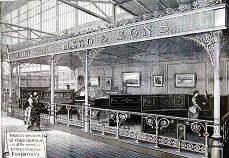
Messers Brinsmead's Pianofortes at the Inventions
Exhibition. Illustration for The Illustrated London News, 8 August 1885
LONDON -
"At
3,589, Messrs. J. BRINSMEAD & Sons, Wigmore-street, show an elegant music
cabinet in American walnut-wood."
The Furniture Gazette, 01/07/1885, p. 311
LONDON
-
"BRINSMEAD,
JOHN, & SONS. —
Concert Grand, with patent leverage, sounding board, &c.;
Semi-Grand, with patent screw tuning pins and continuous iron frame;
Drawing-room Grand, with patent mechanism and tone sustaining pedal
;
Skeleton Piano, with patent screw tuning apparatus and metal action,
&c.;
Upright Piano, with patent leverage sounding-board, &c. ;
Models : patent iron frame, patent screw tuning apparatus, patent
check action, patent simplex action, patent grand check action,
patent leverage sounding-board, &c."
The Musical Standard: A Newspaper for
Musicians, Professional and Amateur, 22/08/1885,
p. 121
MELBOURNE -
"105 Brinsmead, J., & Sons, 10, 20, and 22: Wigmore-st., London. Oblique and
uprig it grand pianofortes."
The Official Catalogue of the Exhibits: With Introductory ..., 1888, p.
10
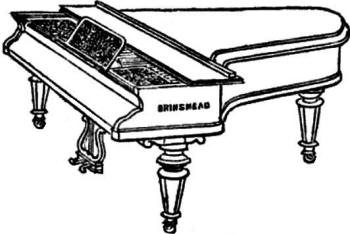
Image of
Brinsmead
Grand Pianoforte
in an advertisement of Kelly & Walsh,
The Directory & Chronicle for China, Japan, Corea,
Indo-China, Straits ..., 1888, p. 418
PARIS -
"4. BRINSMEAD (John) & Son, à Londres, Wigmore street, 18. — Pianos à queue
de diverses formes, pianos droits, caisse intérieure de piano."
Catalogue général officiel de l'exposition universelle
de 1889, p. 16 (gallica.bnf.fr)
LONDON -
"John Brinsmead & Sons have secured a liberal space but content
themselves with showing a sectional piano and illustrations of the numerous
awards and "appointments" with which they have been honoured. This of itself
shows the honours that have been given this enterprising firm from all parts
of the world."
Musical Courier: A Weekly Journal Devoted to Music and the ..., 12/06/1895,
p. 2
BRINSMEAD
on this site
Click on the links above.
For references see page
alfabetic B

© Copyright all rights reserved
|
