home Pianoforte-makers in England


HOPKINSON John & James
in London

1851

LONDON - "Mr. Hopkinson exhibits a grand, with a new action, called “the patent repetition and tremolo check action 5” but as the mechanism is not shewn, we can merely remark that it is intended to give such an extreme degree of repeating power, that a kind of tremolo may be produced by slightly agitating the key when down. The dampers consist of wedges of soft cloth, on the German plan." Newton's London Journal of Arts and Sciences, 1851, p. 34

LONDON - "500. HOPKINSON, JOHN and JAMES, 18 Soho Square — Manufacturers. Horizontal grand pianoforte with patent action, on an entirely new principle, giving increased power and certainty to the touch, and adding the tremolo similar in effect to that produced by the voice. Mata, inventor. Rosewood boudoir pianoforte, 6 and 3/4 octaves." Official description and illustrated catalogue of the Great exhibition, 1851, p. 469

LONDON - "Mr. Hopkinson exhibited a grand pianoforte, to which is applied his repetition action recently patented." Crystal Palace, and its contents : being an illustrated cyclopaedia of the great exhibition of the industry of all nations, 1851, p. 202 (archive.org)

LONDON - "500 Hopkinson, J. & J., Fabr., 27, Oxford Street. – Grosses Pianoforte mit Patent." Amtlicher Catalog der Ausstellung der Industrie-Erzeugnisse aller Völker, 1851, p. 67

LONDON - "Hopkinson has a grand, which is copied from Erard, the lower part pretty good in tone, but not so the upper notes." The World in Its Workshops. A Practical Examination of British and Foreign ..., 1851, p. 204


1855

PARIS - "1997 Hopkinson, J. et J., à Londres, A. — Pianos ordinaires; grand piano perfectionné.
1997 Hopkinson, J. and J., 18 Soho-square, London. Pianofortes."
Paris universal exhibition, 1855, p. 70


1862

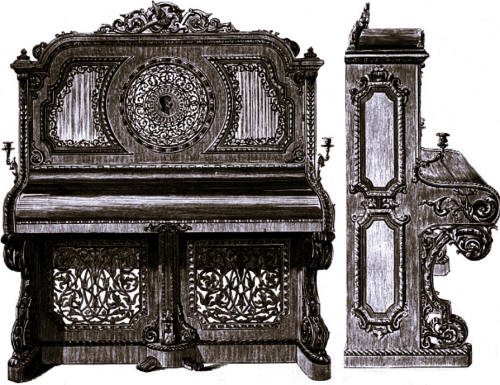
Pianino, Voransicht    &    Seitenansicht
Illustrirter Katalog der Londoner Industrie-Ausstellung von 1862, Volumes 1-2, 1862, p. 82

LONDON - "Die Pianinos von HOPKINSON in Regent Street, LONDON, gehören mit zu den beliebtesten Fabrikaten ihrer Art und werden insbesondere von der Damenwelt bevorzugt.

Ob sie dies mehr ihrer soliden Construction und Klangfarbe, oder ihrer äussern Ausstattung zu danken haben, wagen wir hier nicht zu entscheiden, indessen haben wir es nur mit der letztern zu thun, und dürfen in dieser Hinsicht zugeben, dass bei diesen zierlichen Instrumenten allerdings das Mögliche geleistet ist, um auch das Cabinet-Pianofortes wie dieselben ausdrücklich genannt werden der renommirten Firma." Illustrirter Katalog der Londoner Industrie-Ausstellung von 1862, Volumes 1-2, 1862, p. 82

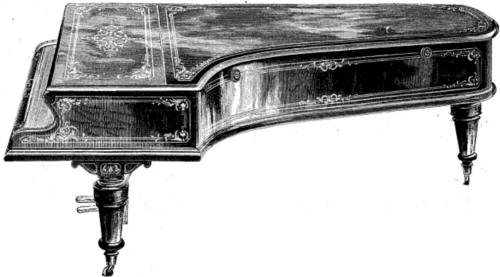
Concertflügel
Illustrirter Katalog der Londoner Industrie-Ausstellung von 1862, Volumes 1-2, 1862, p. 174

LONDON - "Die englische Pianofortemanufactur ist weniger auf dem Continente bekannt, wie im fernen Auslande fremder Welttheile, welche die Hauptabsatzregionen ihrer Producte sind, die sich vor allem durch jene Solidität vortheilhaft auszeichnen, welche der Export nach ungünstigen Klimaten durchaus verlangt.

In der Ausstellung ist dieser Zweig der britischen Kunstindustrie sehr zahlreich und würdig vertreten in einer Menge von Grand, Boudoir-Grand und Cottage-Pianofortes, d. h. von Flügeln, Tafelklavieren und Pianinos.

Eine sehr vollständige Sammlung dieser verschiedenen Instrumente stellen aus J. AND J. HOPKINSON von Regent Street und Conduit Street, LONDON. Wir bilden daraus ab einen wunderschönen Concertflügel, das Gehäuse von polirtem Nussbaum, eingelegt mit Elfenbein, Tulpenbaum und andern kostbaren Hölzern.

Die ganze Ornamentation ist höchst geschmackvoll uns sauber ausgeführt, wie denn überhaupt dieser Flügel schon durch sein Aeusseres sich zur Zierde eines jeden Salons eignen wird. Was seinen Werth als musikalisches Instrument anbelangt, so müssen wir uns hier damit begnügen, hervorzuheben, dass die Manufactur langst wohlrenommirt ist durch die Combination von klarem, vollem und doch delicatem Ton, mit Kraft und Mächtigkeit, und dass sie bisjetzt bei allen Ausstellungen, die sie beschickte, Ehren davongetragen hat." Illustrirter Katalog der Londoner Industrie-Ausstellung von 1862, Volumes 1-2, 1862, p. 174

LONDON - "Nous devons citer encore MM. Hopkinson et MM. Collard et Collard. Toutes ces maisons ont des pianos de qualité supérieure, avec mécaniques à double échappement. Nous avons pu constater que leurs pianos droits sont relativement inférieurs à leurs pianos à queue. Quant à leur fabrication, elle est on ne peut mieux conditionnée." Rapports des délégués facteurs de pianos des délégués facteurs d'orgues-harmoniums et des délégués facteurs d'instruments en cuivre et en bois..., Délégations ouvrières à l'exposition universelle de Londres en 1862, p. 5 (gallica.bnf.fr)

« Cottage Grand Pianoforte, Messrs. Hopkinson. Prize Medal»
«
Patent Concert Grand Pianoforte, with carvings in the italian style »
Cassell's Illustrated Exhibitor: Containing about Three Hundred, 1862, p. 208

& Official Illustrated Catalogue: Class XIII. Philosophical ..., Volume 7, 1862, p. 106

LONDON - "Notice the handsome instrument iii a walnut case, inlaid, by Hopkinson; and, at the back, the oak piano with carving, in the style of decoration of the time of Charles I." Cassell's Illustrated Exhibitor: Containing about Three Hundred, 1862, p. 46

LONDON - "The display of musical instruments on the British side of the building and the second shows a patent concert grand, with all the modern is very complete. Having already referred to these, however, we now merely introduce representations of two fine pianos, manufactured by   Messrs. John and James Hopkinson, of Regent Street.

The first engraving is of a cottage grand, with carvings in the Italian style;  and the second shows a patent concert grand with all improvements. This is inclosed in a case- of admirable workmanship walnut, inlaid with ivory, tulip, box, and king woods, exquisitely carved. But it is not to their cases that pianos owe their chief excellence.

Without tho interior mechanism be of the liret oUfig, all the decoration in the world would render them but boxes of worthless discord. In the pianos of Messrs. Hopkinson — who has not heard them at the Exhibition discoursing "most excellent music," under the guidance of highly-educated fingers ? — the outside ornament forms but the least part of their value.

True, they are fine pieces of furniture; but they possess a far higher value, for they are famous musical instruments. To hear them well played is a treat for a professor, much less a mere musical amateur like the writer. In tone, touch, and all the requisites of first-rate pianos, they are perfect — fitted alike for the concert-room or the cottage parlour — brilliant, full, and at the same time delicate, and calculated in every respect to sustain the high reputation their makers have so long had with the musical world.

The valuable improvements in the manufacture of pianofortes lately introduced have all been taken advantage of by the Messrs. Hopkinson, the resources of whose establishment enable them to compete, not only in excellence, but also in economy of production, with the best makers in the trade.

To go to the Exhibition on a Saturday, and to hear a fantasia on one of these instruments, is a treat indeed; and when we come to consider what a complicated piece of work is the interior of a piano — the strings stretched to a tension equal to a pressure of several tons, and yet one faulty wire putting the whole machine out of order — when we think what ingenious appliances arc necessary before these strings can answer to the light touch of a woman's finger — when we see that all the ends for which such an instrument are fully answered, and we find the English piano a highly-finished and complete box of harmony, our wonder and admiration may well be excited.

To say that these instruments are as perfect as they can be made, is to say all that can be said of any piano yet manufactured: to compare them with the instruments of other eminent makers is simply futile. Among the best there can be no better." Cassell's Illustrated Exhibitor: Containing about Three Hundred, 1862, p. 208-209

LONDON - "3412 Hopkinson, J. & J. 235, Regent-st. — Piano fortes and models." International exhibition, 1862 : Official catalogue of the industrial department, 1862, p. 54

LONDON - "[...] and Mr. Cadby, Mr. Hopkinson, and Messrs. Oetzmann Oetzmann and Plumb various grand and cottage pianos." The Illustrated London News, 14/06/1862, p. 616

« Patent Concert Grand Pianoforte, Messrs. Hopkinson. Prize Medal. »
« Patent concert grand pianoforte. Walnut, inlaid with ivory, tulip, box, and king woods »
Exhibition London, 1861,
Cassell's Illustrated Exhibitor: Containing about Three Hundred, 1862, p. 208
& Official Illustrated Catalogue: Class XIII. Philosophical ..., Volume 7, 1862, p. 106

LONDON - "To Messrs. Hopkinson (United Kingdom, 8412) the Jury award a Medal for great excellence of tone and invention of a pedal for producing the harmonic octave.
Messrs. Hopkinson  xhibit seven pianos, namely : —

1. A full-sized concert grand, in elegantly inlaid walnut case. The action of this instrument is on a peculiar construction originally patented by this firm in 1850, and since considerably improved; the last patent bcing dated in the present year. The ordinary hopper is dispensed with, and its place supplied by a kind of knee-joint. Messrs. Hopkinson have found this action work well, and it gives a good touch, but it has not yet been adopted by any other makers. Models of the new action are exhibited in its original form, and its various stages of improvement.

2. A similar grand, but in plainer case.

3. A boudoir, or short grand.

4. A rosewood boudoir grand, having a highly novel feature in the shape of a harmonic pedal.
This contrivance is so arranged as to allow a frame to descend over the strings, and to drop a light knife-edge of felt exactly in the middle of their length, by which, when the hammer strikes, the tone of the harmonic octave is produced, instead of the fundamental note of the string. The effect is pleasing, and the arrangement so ingenious as to justify favourable notice; but it is necessarily expensive, and must be of doubtful general utility.

5. An upright in elegantly carved case.

6 and 7. Two upright pianos; one of which is constructed to sell at a moderate price, and the other with a new arrangement of the hammer-shaft, compensating for difference between horizontal and upright pianos." Reports by the Juries on the subjects in the thirty-six classes into which ..., 1862, p. 147

LONDON - "Messrs. J. & J. Hopkinson exhibit a concert grand pianoforte, the mechanism (Fig. 693) being upon a new principle, by which increased power is combined with greater delicacy than has hitherto been obtained, and in consequence of reduced friction, the durability is increased.

So sensitive is this mechanism, and so accurately may the amount of tone desired be regulated, that the "tremolo" (similar in effect to that produced by the violinist, or the voice of a finished singer) may be produced by the mere trembling of the finger when pressed upon the key; at the same time a performer of only moderate power of finger can by it fully develop the most powerful effects of the modern style of pianoforte playing.


On the key (1) being pressed, the hammer (2) on reaching the string is relieved by the arm (5) pressing against the stop (7), causing the jointed striker (4) to bend, so as to bring the hammer from the string; the spring (6) keeps the whole in a position always ready to answer to the least movement of the finger on the key, giving the performer a greater command over the action of the hammer on the strings than with the old system of hopper and lever, and securing the utmost delicacy of touch.

It will be seen also that the whole force of the leverage is in this mechanism preserved, and indeed added to, by the straightening of the striker as it ascends, the maximum of force being reached exactly when the hammer strikes the string.


Fig. 694.

The same firm also have an improved "cottage" action (Fig. 694), an invention to remedy a defect in cottage or upright pianos not found in those of the horizontal form, and to compensate for the difference in the position of the hammers between the former and the latter.

By a new form of hammer rail (1), with an altered arrangement of the other parts of the action, the hammer butts (2) are brought close to the string (8); the hammers (3) can no longer attain a vertical position, and their return or relief from the string is more certain and decided. They are not liable to "hang" or produce a reluctant touch. A check (5) is applied to the back of the striker (4) to assist in bringing the hammer to a state of rest after the blow, and to prevent its vibrating against the string (8).

Another invention of the Messrs. Hopkinson is the patent "harmonic pedal," by which the performer can at pleasure produce an entirely new and beautiful effect on the piano, hitherto confined to the harp, violin, and violoncello. It consists of a method of applying stoppers of cork and vulcanized india-rubber, with springs to press lightly on the centres of the strings, producing harmonic sounds of a liquid and pleasing character." The Practical Mechanic's Journal: Record of the Great Exhibition 1862, p. 527


1865

DUBLIN - "804 Hopkinson, J. & J., 235 Regent St. London, W. — Boudoir grand, and patent grand pianofortes; cottage, and grand cottage pianofortes." The illustrated record and descriptive catalogue of the Dublin international exhibition, 1865, p. 239-240


1872

LONDON - "7. Messrs. Hopkinson's grand pianoforte is fitted with a new action, termed “Hopkinson's patent grand pianoforte action.” It is considerably less elaborate than that of Messrs. Erards, and, in the present instance, the touch is well balanced, and secures an instantaneous response.

8. One of the first necessities for obtaining an evenly toned piano, seems to be that the frame-work shall be of such construction and strength that the various degrees of the strings tensions shall not unequally affect it. Perhaps the next necessity is that there shall be a firmness at the point whence the vibrating portion of the string starts.

To obtain this, makers fit the brass studs over which the strings pass on to the iron frame-work. This operation requires much care, and makers —particularly German and American makers — are liable to permit the strings to be too closely connected with the unyielding and comparatively non-communicative iron framing.

Hence the tone of the strings becomes hard and metallic. Some may consider such tone a desideratum. In Messrs. Hopkinson's iron bijou grand the higher notes have rather a uality of tone similar to that above referred to Messrs. Hopkinson show other instruments; one, an upright piano, made for tropical climates.

The weight of this instrument is inconvenient, and the price (200 guineas) unnecessarily made high by ornament, which is called the style of Louis XVI. The framework seems well adapted to insure an inappreciable affection by rapid variations of temperature.

The bijou pianoforte, £25, by. Messrs. Hopkinson, is fitted with an unchecked action, and the hammers are apt to rattle. The tone of this instrument is somewhat weak and uneven." Journal of the Royal Society of Arts, 1872, p. 890-891

LONDON - "An upright grand, inlaid with ivory and ornamental wood, exhibited by Messrs. J. Hopkinson, was placed in the Fine Arts Gallery, in virtue of its excellence of design and workmanship." The British Almanac, 1872, p. 124


1875

YORKSHIRE - "HOPKINSON BROTHERS & Co., Leeds.
a FULL CONCERT GRAND PIANOFORTE, PATENT ACTION.
b BLACK AND GOLD BIJOU GRAND PIANOFORTE.
c BLACK AND GOLD IRON COTTAGE PIANOFORTE.
d WALNUT INCISED OR GILT PIANOFORTE.
e INLAID IRON COTTAGE PIANOFORTE.
f ELEGANT WALNUT-WOOD BICHORD PICCOLO PIANOFORTE.
g, h, i HARMONIUMS. " Official catalogue, Yorkshire exhibition of arts and manufactures, 1875, p. 30


1878

PARIS - "Hopkinson, J. & J. ; Fabricants de pianos et Inventeurs ; 235, Regent Street, London. Fabrique, Fitzroy Road, Regent's Park, London.
Piano a queue en fer, grand format pour concert, mecanisme brevete, caisse de chène.
Piano à queue en fer pour salon mecanisme brevets, caisse en bois de noyer.
Piano à queue en fer pour boudoir, mecanisme brevete, caisse noircie et doree, mecanisme brevete.
Piano «Cottage» en fer, caisse noircie et dorée." Catalogue officiel de la section anglaise, 1878, p. 67 (archive.org)

PARIS - "Hopkinson, J. & J.; Manufacturers of Pianofortes and Inventors ; 235, Regent St., London. Factory, Fitzroy Road, Regent's Park, London.
Iron Concert Grand Pianoforte, in oak case, with patent action.
Iron Drawing-room Grand Pianoforte, in walnut, with patent action.
Iron Boudoir Grand Pianoforte, in ebonised and gilt case, with patent action.
Iron Cottage Pianoforte in ebonised and gilt case. " Official Catalogue of the British Section, Paris Exhibirion, 1878, p. 64

PARIS - "Messrs. J. & J. Hopkinson, of 235, Regent Street, London, send
(1.) an iron concert grand pianoforte in oak case, with patent action,
(2.) an iron drawing-room grand in walnut, with patent action,
(3.) an iron boudoir grand in ebonized and gilt case, with patent action, and
(4.) an iron cottage in ebonized and gilt case." Music Trades Review, Volumes 1-14, 15/05/1878, p. 2

Jobbery at the Paris Exhibition

PARIS - "[...] [...] When we come to consider the English awards in detail, we arrive at still more startling disclosures. And let us at once say that we do not for a moment dispute that the awards, at any rate to the gold and silver medallists, were fully deserved. It is the general opinion of the trade that the exhibit of Messrs.

Hopkinson richly merited the gold medal, while a long course of honours at successive exhibitions since the great London Exhibition of 1851 is evidence of superiority which cannot and will not be disputed.

In a former exhibition at Paris, in an international contest among piano manufacturers of all countries, and at which the names of the makers were concealed from the observation of the judges, Messrs. Hopkinson's pianofortes came off at the top of the tree, while at the great London Exhibition of 1862 the pianos of Messrs. Broadwood and Messrs.

Hopkinson were specially singled out by Dr. Pohl, the official "reporter" to the jurors, as superior to all others. Messrs. Hopkinson, then, have fairly and honourably won fresh honours in 1878, and they are entitled to take, and will indisputably be awarded, every credit for the success they have achieved.

But the injustice has been that in many other cases the awards have been tampered with, altered, and depreciated. We have it on high authority that Messrs. Brinsmead & Sons were
originally awarded a gold, and Messrs. Challen & Sons a silver, medal." Music Trades Review, 15/11/1878, p. 11 - See more about this subjet in
ARTICLES

PARIS - "Messrs. Hopkinson's grand in a fine oak case, and their iron boudoir grand in ebony and gold, both played by Miss Caspar, have been generally praised." Music Trades Review, 15/06/1878, p. 2


1885

LONDON - "At 3,574, Messrs. J. & J. HOPKINSON, New Bond-street, exhibit a Chippendale case in rosewood, with tulip panels. Good designs are shown in open fretwork. The carved legs to some of the walnut-wood grand cases, are worthy of notice. There is also a pianette case in maple wood, with gilt mouldings, and folding keyboard." The Furniture Gazette, 01/07/1885, p. 311

LONDON - "Messrs. R. Hopkinson's grand pianos are made in splendid cases for colonial use, and some are decorated in the style of Angelica Kauffmann. The old fashioned forms of furniture have suggested to Messrs. Challis the idea of a Chippendale pianoforte." The Monthly Musical Record, Volume 15, 01/08/1885, p. 169

LONDON - "HOPKINSON, J. & J. - Horizontal and Upright [overstrung and vertical] Iron Grand Pianofortes ; Pianofortes for extreme climates; Pianofortes with patent organ-pedal attachment; Patent Organ Pedal ; Models of Actions ; Designs for pianoforte cases." The Musical Standard: A Newspaper for Musicians, Professional and Amateur, 08/08/1885, p. 82

LONDON - "Messrs. Hopkinson show a beautifully decorated boudoir grand in the Louis XIV. style, with paintings on the lid representing Comedy and Tragedy, Music and Love; also an upright overstrung grand decorated in the so-called Martin style.

A surface as smooth as ivory or porcelain is produced by several coatings of varnish, and the paintings executed on this have a peculiar depth and softness.

Mention should be made of the organ pedal attachment on the "safety escapement" principle, which, it is asserted, is superior to all other actions, in that the slightest pressure of the foot is sufficient, while no amount of force can do any damage to the piano." The Athenaeum: Journal of Literature, Science, the Fine Arts, Music and ...,20/06/1885, p. 800


1886

EDINBURGH - "1116 Hopkinson, J. & J., London, Agents, John Wightman & Son, Castle Street, Edinburgh. Concert and Drawing-Room Grand Pianofortes and Cottage Pianofortes, all with complete iron frames, check action and full trichord. Cottage Pianoforte with Organ Pedal attachment." The official catalogue, Edinburgh international exhibition, 1886, p. 206


1888

MELBOURNE - "110 Hopkinson, J. & J., 95 New Bond-st., London. - Grand and cottage pianofortes." The Official Catalogue of the Exhibits: With Introductory ..., 1888, p. 10


1910

BRUSSELS - Zeitschrift für Instrumentenbau, 11/11/1910, p. 154-155 (daten.digitale-sammlungen.de)

HOPKINSON
on this site

 
EXPOSITIONS
ARTICLES
BIOGRAPHY
ADVERTISEMENTS

Click on the links here above

For more information and references see page
alfabetic H


 © Copyright all rights reserved