home Pianoforte-makers in England


BROADWOOD
in London

1810

"A FEW days since, an affair of honour took place near Chalk Farm, between two journeymen in the employ of Messrs. Broadwood and Co. piano-forte makers, which ori ginated in a dispute the preceding evening, respecting the tuning of an instrument.

At an early hour the parties met, attended by their seconds, at the bottom of Primrose Hill, when, after exchanging two shots, one of the combatants either supposing himself wounded, or apprehending the consequence of a third fire, dropped down.-

Some labourers, whom the reports of the pistol had attracted, coming up at the time, and his adversary taking them for officers of Police, made his escape, and has not since been heard of." Sporting Magazine, 1810, p. 38

1836

Ankündigung für die Verehrer Beethoven's.

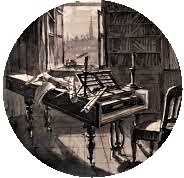
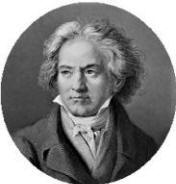
"Als Beethoven in der Blüthe seines nun unsterblich gewordenen Ruhmes stand, erhielt er bekanntlich von den grössten Tonkünstlern Englands ein Fortepiano aus der weltberühmten Fabrik des Herrn Broadwood in London als eine Anerkennung und Huldigung zum Geschenk.

Dieses Fortepiano, mit den Inschriften aller dieser Tonkünstler versehen, welches durch die 20 letzten Jahre von Beethoven zum Spiel und zur Composition benutzt worden ist, und dessen Aechtheit legal nachgewiesen werden kann, wird nun von seinem gegenwärtigen Besitzer (welcher es nach B.'s Tode in der Auction käuflich erstand) allen Liebhabern wahrhafter Denkwürdigkeiten und allen Verehrern des Beethoven'schen Genius zum Kaufe ausgeboten.

Es ist von massivem Mahagoniholze, hat den Umfang von 6 Octaven (von dem Contra-C bis zu dem viergestrichenen C), ist gut conservirt und hat alle Eigenschaften der soliden englischen Mechanik und Bauart. Nähere Nachweisung ist auf portofreie Briefe zu erlangen in der Musikalienhandlung von Friedr. Kistner in Leipzig." Allgemeine musikalische Zeitung, 06/1836, p. 48 - See also article in 1892 about Beethoven's pianoforte (here below) !

1853

MAHOGANY & ROSEWOOD

"Mahogany. —  This is the wood of a tree growing in the West Indies and Central America. There are two other species of Swietena found in the East Indies, but they are not much known in this country.

The mahogany is one of the most majestic and beautiful of trees; its trunk is often forty feet in length and six feet in diameter; and it divides into so many massy arnu, and throws the shade of its shining green leaves over so vast an extent of surface, that few more magnificent objects are to be met with in the vegetable world.

It is abundant in Cuba and Hayti, and it used to be plentiful in Jamaica; but in the latter island, most of the larger trees, at least in accessible situations, have been cut down.

The principal importations into Great Britain are made from Honduras and Campeachy. That which is imported from the islands is called Spanish mahogany; it is not so large as that from Honduras, being generally in logs from twenty to twenty-six inches square, and ten feet long; while the latter is usually from two to four feet square, and twelve or fourteen feet long, but some logs are much larger.

Mahogany is a very beautiful and valuable species of wood; its color is red brown, of different shades and various degrees of brightness, sometimes yellowish brown; often very much veined and mottled, with darker shades of the same color.

The texture is uniform, and the annual rings not very distinct. It has no large septa, but the smaller sepia are often very visible, with pores between them, which in the Honduras wood are generally empty, but in the Spanish wood, are mostly filled with a whitish substance.

It has neither taste nor smell, shrinks very little., and warps or twists less than any other species of timber. It is very durable when kept dry, but does not last long when exposed to the weather.

It is not attacked by worms. Like the pine tribe, the timber is best on rocky soils, or in exposed situations.

That which is most accessible at Honduras, grows upon moist, lov land, and is, generally speaking, decidedly inferior tc that brought from Cuba ind Hayti, being soft, coarse and spongy; while the other is coarse-grained ind nard, of a darker color, and sometimes strongly figured.

Honduras mahogany, has, however, the advantage of holding glue admirably well; and is, for this reason, frequently used as a ground on which to lay veneers of the finer sorts.

The best qualities of mahogany bring a very high price. Not long since, Messrs. Broadwood, the distinguished piano-forte manufacturers of London, gave the enormous sum of £3000, for three logs of mahogany.

These were the produce of a single tree, each about fifteen feet long, and thirty-eight inches square; they were cut into veneers of eight to an inch. The wood was particularly beautiful, capable of receiving the highest polish; and when polished, reflecting the light in the most varied manner, like the surface of a crystal; and from the wavy form of the pores offering a different figure in whatever direction it was viewed.

Dealers in mahogany generally introduce an auger before buying a log; but notwithstanding, they are seldom able to decide with much precision as to the quality of the wood, so that there is a good deal of lottery in the trade. Mahogany was used in repairing some of Sir Walter Raleigh's ships at Trinidad, in 1597; but it was not introduced into use in England, till 1734.

Rosewood is one of the most beautiful and costly of the fancy woods; it is produced in Brazil, the Canary Isles, Siam, &c. The logs often are twenty-two inches in thickness. Considerable quantities are imported into this country, and 300 tons are annually sent to Great Britain." Enterprise, Industry and Art of Man, 1845, p. 304

1854

MAHOGANY from the BAY ISLANDS

"The annual exportation for many years has ranged from five to simillion feet. The tree is of immense size, and has a magnificent appearance, from the spread of the branches ; it is said to require 200 years to arrive at full growth, and be fit for catting.

The trunk is most valuable on account of its dimensions, but the branches or limbs are preferred for ornamental purposes, the grain being closer, and the veins more variegated.

The trunk is sawn into logs, which are subsequently roughly squared, for the convenience of ship stowage. The largest log known to have been cut in Honduras was 17 feet long, 5 feet 4 inches deep, and measured 5,168 cubic feet = 15 tons weight.

The wholesale prices vary, at Liverpool, from bd. to 9d. per foot. Messrs. Broadwood, the pianoforte-makers, are stated to have given ₤ 3,000 for three logs of mahogany, the produce of a single tree : they were each about 15 feet long by 38 inches square ; and were cut into veneers of eight to an inch. The grain of this tree was particularly beautiful. When highly polished, it reflected the liglit like the surface of a crystal ; and, from the wavy form of the pores, presented a different figure, in whatever direction it was viewed." The British colonies : their history, extent, condition and resources, 1854, p. 169 (archive.org)

1863

BROADWOOD AND SONS' PIANOFORTES

 "The Grand Pianoforte may be said to have been born in England; for although its inventor, Americus Backers, was a Dutchman, it was in Jennyn-street, about the year 1767, that the instrument was originally planned. Backers was a manufacturer of harpsichords.

Instead of clothing the strings (when first "applying hammers"), he merely caused them to be struck by soft wood or cork, with a view to obtain the harpsicord tone so much admired at that period. Subsequently, however, he adopted a thin covering, of leather.

His mechanism, which possessed, the double merit of effectiveness and simplicity, competed successfully with that of the most noted and ingenious of his contemporaries, and was gradually adopted by the principal makers, not only in this country, but on the continent, where it was specially recognised as the "Mecanique Anglaise," or "Die Englische. Mecanik."

Upon his decease (somewhere near 1781), Backers, proud of his discovery, confided it to the future keeping of his friend, John Broadwood, who, while in the employ of Burkhard Shudi, used to go every evening, accompanied by his own apprentice, Robert Stoaart,t to assist in bringing it to perfection. Broadwood, nevertheless—subsequently engaged in other projects—bestowed little thought on the new instrument, until several years later.

He had, in 1778, succeeded to Tschudi's business (Great Pulteney-street); and his increased responsibilities absorbed the whole of his time and attention, Meanwhile Robert Stodart, who, at the expiration of the term of his apprenticeship with Broadwood, commenced "making" on his own account (in Golden-square), had applied himself with eminent success to the manufacture of Grand Pianofortes, on the model of Backers, his opportunities of acquiring familiarity with which have been described.

Besides materially improving the mechanism in several essential particulars, he increased the power and enriched the quality of tone. The vogue and extensive publicity which the new instrument deservedly obtained, under Stodart's name, at length awakened John Broadwood to a sense of its importance.

For some years Broadwood emulated his contemporary with but indifferent success, till Muzio Clementi (as influential a friend to him as Handel had previously been to Tschudi), through continually pointing out the detects of his instrument, and urging him to profit by the experience and counsel of eminent musicians and men of scientific acquirement, not only roused the pride of one to whom the art was already in some degree indebted, and who had succeeded to an inventor and manulacturer of the highest eminence, but particularly excited his interest in the progress and improvement of the Grand Pianoforte.

Among the rest he solicited and obtained the advice of Cavallo, the author of A Treatise on Acoustics, and other works, which at that period were in high repute. Cavallo, having deduced from the Monochord a theory concerning the length and proper tension of the strings of the pianoforte, drew up a paper on that very interesting and important subject, which he subsequently read, with great success, at one of the meetings of the Royal Society.

Dr. Gray, too, formerly of the British Museum — who, after certain valuable experiments, had fixed the absolute proportions of gravity and vibration, respectively belonging to strings of brass and strings of steel (which first led to a division of the bridges on the sounding board of the Grand Pianoforte) — was also one of Broadwood's advisers.

With the aid of these dist inguished men, he advanced so rapidly, that his reputation as a manufacturer of Grand Pianofortes was in a brief space established; and as a proof of the worth of those modifications and improvements which the suggestions of Cavallo and Dr. Gray had emboldened him to carry out, they were speedily adopted by every maker of note, both in England and abroad." The Musical World, march 1863, p. 163

1865

"L'INDUSTRIE DES PIANOS. — La plus grande manufacture de pianos est celle de Broadwood et fils, de Londres. Elle existe depuis 1780, et a été fondée par le grand père des propriétaires actuels. Il résulte des registres que 132 000 pianos sont sortis de ses ateliers." La Science pittoresque : journal hebdomadaire, 1865, p. 132 (Gallica)

1879

« Cover of a pianoforte,
 designed and painted by E. Burne Jones
 for the instrument in the possession of W. Graham. »
 Is this from a Broadwood ? The English Illustrated Magazine, Volume 1, 1884, p. 224

"Messrs. Broadwood and Co.,"states the Athenœum," have just finished a noble pianoforte, designed in an old English style, and carefully decorated in accordance with the instructions of the painter, for Mr. E. Burne Jones.

It is with pleasure we notice the application of fine artistic skill to the enrichment of musical instruments, an application of which several instances have occurred since described that sumptuous example which was made by Messrs. Broadwood and Co. for Mr. Alma Tadema." Bazaar Exchange and Mart, and Journal of the Household, Volumes 20-21, 16/07/1879, p. 34

1882

Mr. Alma Tadema's pianoforte
The Buiding News, 01/09/1882, p. 271

"VISITORS to the Grosvenor this season will scarcely have overlooked the admirable portrait by Mr. Alma Tadema of the composer, pianist, and vocalist, Mr. George Henschel, who is represented as singing, and with his fingers touching the keys of a pianoforte of unusual design and decoration.

This pianoforte we have now represented in full view, but other pianists occupy the seat, and we recognise that the duet belongs to the music of home. The figures have been drawn by the distinguished painter himself, and add a personal interest to the picture.

To render Townshend House complete, musically as well as artistically, Mr. Alma Tadema recently gave Messrs. John Broadwood and Sons the commission to make this remarkable instrument, after the design and drawings of Mr. G. E. Fox, an architect who is engaged in restoring the internal decoration of Warwick Castle.

The room the pianoforte stands in being in the Byzantine style, with gold walls and ceiling, the design of Mr. Fox, including the seat for the player, an essential part of it, is in perfect keeping, and fulfils the intention of the owner, at the same time not in any way losing its independence from more furniture as a musical instrument.

The usual form of Broadwood's grand piano has been preserved, but the supports are of more sustantial and truly architectural character, the columns being alternately of rosewood and ebony, while the instrument, case and cover or top, is of oak.

The very large masses of fine ivory employed in the carved acanthus ornament of the sides of the keyboard and about the seat, itself almost a throne, first attract the eye, and this material is carried round the frieze of the case in tear drops, a suggestion from St. Sophia at Constantinople.

The sides of the case are panelled, and the carved side bears, in addition, devices presenting the lark, owl, and cuckoo, with their characteristic notes in old musical notation. The top is adorned with geometrical patterns in mahogany, white woods, ebony, tortoiseshell and mother-of-pearl, in jewel-like effect; gilding and brass have also their place in this sumptuous masterpiece.

Inside the piano, the iron framing, plate and tension bars, are painted with a beautiful pattern. The old harpsichords had frequently paintings, and sometimes by eminent masters, on the under side of the top, shown when that covering was raised for performance.

Mr. Tadema, with that happy invention that characterises him, has had sheets of vellum framed to enhance the musical value of the instrument by the approving signatures of his musical friends who have played upon or in concert with it.

Already the autographs of Mlls. Mehlig, Krebs, and Janotha; Mmes. Essifroff and Haas; Messrs. Joachim, Sarasate, Scharwenka, Henschel, and others known to fame, are conspicuous upon it. Behind the satin curtain with rare gold embroideries, shown in the drawing, a Byzantine window has recently been constructed, that lights piano and room through beautiful glazings of Mexican onyx.

The initials of Mr. L. Alma Tadema have been frequently and tastefully employed in the monograms and other devices about this superb production of Messrs. Broadwoods, the whole of the work, including the decoration, having been accomplished by them.

Since the pianoforte has been at Townshend House, Mr. Alma Tadema has commissioned the Neapolitan sculptor, Professor Amendola, to execute a silver plaque in high relief, representing the Drowning Orpheus, borne upon the Waves towards the Thracian shore. This fine work is let into the panel at the narrow end of the instrument, and adds an additional interest to it." The Buiding News, 01/09/1882, p. 260

"There is no furniture in this sumptuous little room, save the sparse seats, and the grand piano, of which all the world has heard, designed by the owner, made by Broadwood, and which is as full as everything else in his house of his fingular and original taste.

Cedar, ivory, and fine brass-Solomon himself, had he lived in the days of fuch musical instruments, would not have disdained such a gift from the Queen of Sheba's hands.

The very screw nails which rivet part to part, in lieu of the single cut to admit the screw-driver, wear a little LT on their favoured heads.

The delicate chafing and details, and the whole redeemed design, answer the idle cry that a pianoforte can never be an artistic object, and show that it can, if knowledge of art and mechanical construction are both brought to bear on it.

The interest of its beauty is heightened by the autographs of celebrated pianists, who have inscribed their names on the parchment inside the lifting flap, after performance on the keys." Beautiful Houses, Haweis, 1882, p. 28

1883

"A SUMPTUOUS PIANO. - Messrs. Broadwood have just completed a concert iron-grand for His Grace the Duke of Westminster. The case is very extraordinary, and the instrument is supported by eight legs. Ormolu mouldings, comprising no less than 500 metres of brass work, overlaid with solid gold leaf, adorn the panels and sides of dark rosewood. Grosvenor House is the fortunate destination of this chef d'œuvre." The Furniture dealers' and cabinet makers' guide, 17/09/1883, p. 140

1887

again about Alma Tadema's piano

"The remaining Associate, Mr. George Aitchison, sends a drawing of the decoration of a drawing-room at Grosvenor Crescent. In this connection, also, may be mentioned the drawing of the grand piano designed by Mr. Alma Tadema for the same New York music-room for which the President painted the ceiling and frieze exhibited last year.

Mr. Tadema has designed all the furniture of the room in a kind of Neo-Grec style, and this piano is made to harmonize therewith. It is a wonderful piece of work, full of wonderful detail in all manner of precious woods, ivory, mother-of-pearl, etc.

The general design of the case and the decoration of the top is very good, but the feet are far too massive, a fault which may also be applied to the metal music-rest. The pedal-frame is fashioned of two Greek Doric columns with an entablature over them, all very neat and complete." The American Architect and Building News, Volume 21, 25/06/1887, p. 305

1888

Grand piano of Broadwood,
designed by Burne-Jones and Edward Coley,
decorated by Kate Faulkner,
made in 1883
 to see the Museum V&A South Kensington

"But, in one way, the piano by Messrs. BROADWOOD, which is ornamented in gesso by Miss FAULKNER, is the most novel application of the material. The detail is fine and the general effect is rich.

The question will arise whether the oak case could not be made to look as handsome without coating it with gesso.

The piano is one of those things which could not come into existence without an organisation that has a close resemblance to division of labour. Miss FAULKNER designed and executed the decoration, but no less than ten names are given of men who were employed on the case and instrument.

The cassone which Mr. BURNE-JONES has designed and painted is an innovation. The workmanship is excellent.

Mr. CHARLES LUMLEY made the chest, and the gesso-work is by Mr. OSMUND WEEKS, who is well represented in the Exhibition. The gilding is as uniform as if received in a dip, like an ordinary colour in a pottery.

Comparisons will be made between the garden scenes painted on the cassone by Mr. BURNE-JONES and on a hanging cupboard by Mr. SPENCER STANHOPE, both corresponding in spirit." The Architect: A Weekly Illustrated Journal of Art, Civil ..., Volume 40, 09/11/1888, p. 259

1892

about the T. G. Jackson Grand Piano

N°. 326. - Case of a grand Pianoforte for N°. 2 Kensington Court.

"Jackson, A.R.A., architect. This is a new instrument made by Messrs. Broadwood. The case, designed by Mr. T. G. Jackson, A.R.A., is laid outside with intarsiatura of satin-wood, shaded and engraved, with occasional use of mother-of-pearl and tortoiseshell. The inside of the lid is decorated with enamel painting and a pattern of gesso gilt.

The shields and cartouches bear each a few bars from works composed for the clavier, harpsichord or piano, by Bach, Handel, Bird, Gibbons, Purcell and Arne.

The stand on which the instrument rests is of walnut, and the ground of the veneer is of wood stained to a greenish-black colour. The stand is made at Messrs. Broadwood's works, and the intarsia is done by Mr. Bessant, of Cavendish Works, Charlotte Street, Portland Place, W." The Architect: A Weekly, 04/03/1892, p. 1 (see two images of this pianoforte here below)

again about the Thomas Graham Jackson (1835-1924) Grand Piano

AN ART PIANO.

"THE decorated grand piano on exhibition at 33, Great Pulteney Street from the 24th to the 27th ult. was expressly made to the order of Mr. and the Hon. Mrs. Athelstan Riley, of Kensington Court.

In August, 1890, Messrs. Broadwood & Sons commenced the instrument according to the specification and drawings of Mr. T. G. Jackson, A.R.A., of 14, Buckingham Street, Strand.

The internal construction took a year to accomplish. On the 27th of August, 1891, the unfinished instrument was delivered at the workshops of the eminent cabinet-maker Mr. Bessant, in Charlotte Street, Portland Place, for external decoration.

As directed by the designer, the piano had been made in the rough in solid Honduras mahogany, and the keys had been finished with thick unbleached ivory fronts, with “ turned arcading."

The ebony sharps had also been veneered, on their upper surface, with ebony and ivory slips converging diagonally.

On the 21st of July, 1892, Mr. Bessant returned the pianoforte to John Broadwood & Sons' manufactory in Westminster. Since that time four months have been occupied in final fittings and work, so that the piano has altogether taken a little more than two years to make.

Internally it resembles the Broadwood concert grand, modified slightly in size. In this piano the massive framing of wrought and cast iron has been specially moulded to conform in outline to the design of Mr. Jackson.

 In regard to the case, the first thing that will arrest the attention is the unusual appearance of the sharps, or black notes. These sharps, chequered with ivory inlays, and naturals "arcaded," are a bold attempt on the part of Mr. Jackson to revive a style in vogue in the "good old days" in the keys of the precursors of the piano.

The ebony name-board will next be noted. Adorned with lilies of the valley and arabesques, the name-board bears, in marquetry, the followin following inscriptions: in the centre, for their work. An agitation, if any were | "Johannes Broadwood, cum Filiis, faciebat 1892"; at the bass end, "T. G. Jackson, A.R.A., architectus, delineavit"; and at the treble end, "C. H. Bessant, faber intestinarius, ornavit."

Mr. Jackson has in this piano generally substituted angles for curves in the outline of the body of the instrument, although not in the decorative details. Thus, instead of being bulged out in the usual way, the tail, or small end of the piano, terminates in an acute angle, harpsichord fashion.

Again, instead of being rounded off into the customary "fall," the keyboard cover and front are rectangular, and the mouldings round the top incline to be "straight" rather than semicircular. Piano legs have frequently displeased the nineteenth century artist.

Mr. Jackson's treatment of the underbearings is unique. From time to time pianos have been furnished with trusses, pilasters, brackets, straight legs, consoles, legs serrated, crinkled, quadrangular, and polygonal, of myriad different types, all with more or less imperfect result. Here Mr. Jackson supersedes the conventional "legs" by a stand of rich black (or rather dark brown) walnut.

At either extremity of the keyboard, and at the tail end of the instrument, are triplet pillars. The outer pillars are cylindrical, of a severe Grecian shape, the central support of each trio being bulbous towards its base, and more taper than its neighbours. Each trio of pillars rests upon a plinth, and upholds an architrave of black walnut.

From the plinth at the bass side there extends a stout beam underneath the key-board to the plinth at the treble side; and from the centre of this lateral beam (by the pedals, and at right angles to the lyre) there extends a longitudinal beam to the plinth at the extremity.of the instrument.

The most novel feature in Mr. Jackson's stand, however, is the introduction of a pair of carved scrolls facing each other, vis-à-vis, forming, as it were, the two haunches of an arch bearing up the ponderous body of this piano With these scrolls the two arms of the pedal-lyre correspond in design.

The outside of the piano itself is veneered with purple wood, stained an exceedingly dark green (not black), and the effect of the natural dye in the wood, combined with the chemical used, produces the appearance of a very fine old ebony.

The surface is dull polished. Elaborate intarsiatura, representing a profusion of lily stems, leaves, and blossoms in satinwood and pear tree, dissipate the sombreness of the dead black in a striking manner.

To heighten the effect, the blooms are made to scintillate with the iridescent tints of mother-o'-pearl, each lily being literally "painted," its centre being overlaid with transparent and variegated tortoiseshell, through which a rich red enamel effectively gleams.

The top is fastened to the body of the piano by means of long and elaborately chased brass hinges of vine-leaf pattern. By the introduction of classic tablets, or shields, the appearance of the exterior is considerably enhanced. Upon these shields are emblazoned well-chosen excerpts from some of the old tonepoets, reminding one of the quaint charm of the music in which one's ancestors delighted.

These excerpts are as follows : On the top, six bars from a Courante in G by Henry Purcell; upon the treble side an extract from 'Sellenger's Round,' by W. Byrde; upon the centre of the bent side, 'Preludium,' by J. S. Bach; on the tail end, Allegro in F, by Thomas Augustine Arne; on the centre of the bass side, opening bars of Handel's 'Harmonious Blacksmith'; and by the bass end of the key board, 'Preludium' by Orlando Gibbons.

The entire background of the top as well as the inside of the case is enamelled vermilion, and this enamel is brightly lacquered. Upon the shining surface, in lyre-shapes and semi-circular curves and contours, sway golden laurel boughs, laden with golden berries, amid which golden finches twitter gaily.

These ornaments are executed in gesso. One foliage spray encircles an "A. R.," the monogram of the owner of the piano. A border of ebony inlaid with satinwood and mother-o'-pearl fittingly frames the Japaneselike picture presented by the red enamelling and golden gesso. Golden leaf covers the iron framework of the piano.

Over this fr framework, by the tuning-pins, is placed the music-desk, of satinwood, rectangular in pattern, and it is inlaid with walnut, mother-o'-pearl, tortoiseshell, holly, and ebony. Light square satin-and-walnut bars support a centre panel of walnut relieved with floral marquetry. On either side of the desk are the candle-boards, embellished with inlaid poppies, the centres of the blossoms being of tortoiseshell placed over red enamel." Music Trades Review, 15/11/1892, p. 17

1893

again about the Thomas Graham Jackson (1835-1924) Grand Piano

Grand Piano,
 designed by T. G. Jackson, A.R.A.
The Magazine of Art, Volume 16, 1893, p. 107
& The Builder, Volume 64, 07/01/1893, p. 5

"The grand piano, of which we give two aspects, was designed by Mr. T. G. Jackson, A.R.A., for Messrs. Broadwood and Sons, to the order of Mr. and the Hon. Mrs. Athelstan Riley.

It is a beautiful example of what can be done by the co-operation of art and craft. Mr. Jackson's design is altogether novel and pleasing, not only in its decorative treatment, but in the actual form of the instrument itself. This is especially marked by the way in which he has avoided the difficulties connected with the supports of the pianoforte, which have so puzzled designers in the past.

He does away with the conventional legs, substituting a stand composed at either end of a series of pillars of classic form connected by beams, from which spring a pair of carved scrolls suggesting an arch, upon which the body of the instrument is supported. Mr. Jackson has thus adopted a method which is at once graceful and unique.

The inside of the lid is richly decorated with laurel boughs, wrought in golden gesso on a background of vermilion enamel, the chief motive following the form of a lyre-bird's tail, while the border is composed of ebony, inlaid with satin-wood and mother-of pearl.

The outside of the case is also very effective, the dark colouring of the top (obtained by applying a very dark stain over a veneer of purple wood) being relieved by bright inlays of mother-of-pearl and tortoiseshell round the sides, while at intervals are shields containing a few bars from well-known classic compositions.

The keyboard is varied The keyboard is varied by the black keys being chequered with ivory inlays, while the "naturals" are elaborately carved at the ends. The hinges and other fittings are of brass, richly chased." The Magazine of Art, Volume 16, 1893, p. 107-108

Grand Piano,
Designed by T. G. Jackson, A.R.A.
The Magazine of Art, Volume 16, 1893, p. 107
& The Builder, Volume 64, 07/01/1893, p. 6

Reproduction from original Working Drawings
 for the Design of the inside of the Lid of Grand Pianoforte. - By T. G. Jackson, A.R.A.

The Builder, Volume 64, 07/01/1893, p. 13
->>> by another article « Design for a Grand Piano »,
The Builder, Volume 64, 07/01/1893, p. 15

Oblong Grand Piano,
designed by T. Myddleton Shallcross,
executed by Messrs. Broadwood and Sons,
Studio international, 1893, p. 135 (archive.org)

"LIVERPOOL. — In the construction of the grand piano an erroneous impression appears hitherto to have been prevalent amongst designers and manufacturers that the harp or ogee-shaped frame and sound-board were alone practicable, and that the oblong shape used for the harpsichord and for some grand pianos a hundred and fifty years ago could not be retained for the modern instrument. Consequently any satisfactory treatment of the design of a grand piano case, from the architect's and decorator's point of view, has long been a difficulty.

Mr. T. Myddelton Shallcrosa has essayed to meet certain definite requirements of piano construction, so that the case may be moreconformable with other decorative objects in a well - designed room, and in this endeavour he has been very ably seconded by Messrs. Broadwood & Sons, whose careful experiments have led to the production of their Steel Barless Oblong Grand Pianoforte.

Our illustration shows an oblong-grand Piano, designed by Mr. Shallcross and made by M Broadwood, the case being chiefly of oak stained green and Hungarian ash stained blue, with interior panels of white holly painted with conventional designs by Mr. F. C. Varley.

The metal work of the piano frame is silver-grey enamelled, the hinges of the top are hammered iron, with the natural colours produced by the forging retained. Owing to the oblong shape the top may be hinged either upon the treble side or the bass side of the instrument, whichever may best suit the acoustics of the room.

The sides and top are brought to the front to cover the keyboard, but, by hinging part of the sides, the performer is permitted free use of his hands for the full width of the keyboard. The music rest and candle brackets are made adjustable to the positions most convenient to the performer.

The stand of this piano is a separate piece ot framing, apart from the case ; this secures great rigidity when the two are fixed together by screws and dowels. The attempt Mr. Shallcross has made may possibly attract the attention of those who desire to see improved design upon the lines of the oblong-grand piano." Studio international, 1893, p. 135-136 (archive.org)

1894

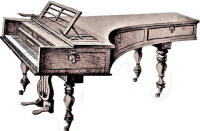
"Beethoven's Broadwood grand piano, now belonging to the National Museum at Budapest, has an important place among the Beethoven relics in the Vienna Exhibition. The following description of it is translated from the recently published catalogue of the German and Austro-Hungarian Loan Collection :

"Beethoven's grand piano, manufactured by John Broadwood & Sons, of London. With the name Beethoven inlaid, and inscribed upon the wrest-plank 'Hoc instrumentum est Thomae Broadwood (Londini) donum propter ingenium illustrissimi Beethoven.'

Then follow, written in ink, the autographs of Ferd. Ries, J. B. Cramer, G. G. Fe...ai (?), and C. Knyvett. Three unisons, compass six octaves (C-C), two pedals (raising the dampers and shifting) without iron framing. Belonged to Franz Liszt.

The query in the catalogue is easily answered by filling in Ferrari, the name of a well-known musician who accompanied Mr. Broadwood to Vienna when he made Beethoven's acquaintance.

This is consequently the identical piano Beethoven wrote about under date February 3rd, 1818, to the late Mr. Thomas Broadwood, saying (vide Grove's 'Dictionary') that he would regard it as an altar on which to lay the finest offerings of his genius.

That he appreciated the instrument was shown by the care he took of it, for he would only allow one man to tune it, Herr Stumpff, and his praise of it to Friedrich Wieck, to whom he showed a hearing apparatus he had made for it connected with the sound-board.

It remained with him until his death, and was then sold by auction. It was again sold by auction in 1836, when Spina bought it for 181 florins! Later on it became, as is well known, the property of the Abbé Liszt, after whose demise in 1886 it was given to the Budapest Museum.

Somebody who did not know what he was writing about, recently talked nonsense about an alleged con. siderable increase in the touch resistance in the Broadwood pianos, and Messrs. Broadwood took the trouble to test a certain number of their pianos in various ways.

The trouble was unnecessary, but in the result Messrs. Broadwood, who for years past have endeavoured, as far as practicable, to lighten the touch, have issued a very interesting table, which they have forwarded us for reproduction here. It will be seen that during the past few years the touch has been very materially reduced :

Music Trades Review, 15/09/1892, p. 31

1894

CONCERNING A PRINTER'S ERROR.

  "33, Great Pulteney Street, London, W.
Oct. 2nd, 1894.

To the Editor of THE ARTIST.

SIR, - Our attention has been called to the October number of THE ARTIST, in which an article, entitled "Is the Pianoforte a thing of Beauty," contains, on page 388, the following passage :

"Judged by the standard of antiquity of so many other musical instruments-for the pianoforte can be a musical instrument as well as an indispensable article of furniture-the pianoforte belongs but to yesterday. No one further back than Signor Cristoforo, of Padua, in 1710, or our own Father Smith a year later, thought of this instrument seriously, and we doubt very much whether the really practical combination of talents was found in this art trade before the young Scotch carpenter came to London in 1751 and married the daughter of Trehudi, the great harpsichord maker, and founded the firm of Brinsmead."

This statement is entirely unfounded, and may mislead the public by inducing the belief that the and general art work history relating to the foundation of the firm of John Broadwood and Sons relates to the foundation of the firm of Brinsmead.

The true account is well known, and is to be found in Sir George Groves' " Dictionary of Music and Musicians," at page 278, and the true facts are also personally known to Mr. Edgar Brinsmead, who, in his publication styled "The History of the Pianoforte," published by him in the year 1889, states, at page 122 to 123, as follows :

"In the year 1751, John Broadwood, a young Scotch carpenter and joiner, about twenty years of age, arrived in London, and succeeded in obtaining a situation in the employ of Tschudi, where he rapidly rose into favour with Mr. and Miss Tschudi. Like the proverbially good apprentice, he married his master's daughter, and became his partner and successor. In 1776, Becker, or Backers, assisted by John Broadwood, and another workman in the employment of Tschudi, Robert Stodart, after many experiments, succeeded in producing the grand action which was used by Stodart until the time of the dissolution of the celebrated firm founded by him. This mechanism has been used by the firm of John Broadwood and Sons, with slight modifications, until the present time. The first mention of a grand pianoforte, made with this action, is found. in the books of Tschudi and Company, under date 1781."

It is untrue that the firm referred to by your contributor was founded in 1751 by the young Scotchman who married Miss Tschudi, not Trehudi, as mis-spelt by the writer of the article referred to.

We hope that you will consider that, in common fairness, and as a matter of justice to ourselves, we are entitled to ask that the mis-statement should be corrected by your inserting a copy of this letter in your next issue

We remain,
Yours obediently,

JOHN BROADWOOD AND SONS.

[We much regret the mistake, which was entirely our own oversight. Messrs. Brinsmead have also written to us to correct the printer's error. The series of articles commenced last month on this important question of modern furnishing will be continued in the next issue.--ED.]" The Artist, 11/1894, p. 424-425

"The will of Mr. Henry Fowler Broadwood, head of the firm of John Broadwood & Sons, the piano manufacturers, who died at his country seat, Lyne House, near Horsham, at the age of eighty-two years, has been proved in London by the executors named therein. The value of the testator's personal estate amounted to 71,407∫. The testator left his capital and share in the business to his son, Mr. Henry John J. Broadwood." Music Trades Review, 15/11/1894, p. 29

1895

Piano made by Messrs. Broadwood.
 Designed by Mr. G. Henschel,
The Musical Courier, 21/11/1895, p. 28

Mr. Henschel's New Piano.

"MR. R. HENSCHEL, one of the most versatile musicians of our time, conceived the idea of changing the exterior of the modern grand piano so as to make its appearance more consistent with the established rules of architectural and ornamental art.

Mr. Henschel has an ideal music room constructed after his own plans, and in one of his imaginative moods he conceived the outlines and general principles that have governed the construction of the case of the present piano which has longed for as a complement to his artistic surroundings.

The suggestions he submitted to Messrs. John Broadwood & Sons, who have every facility for executing any possible design; indeed their many and varied examples of these special pianos are widely known.

Mr. George Rose, who has under his superintendence the construction department, at once comprehended Mr. Henschel's suggestions, and with his competent force immediately set to work to make this new model instrument.

Much has been written of late concerning the want of symmetry in the outline of the conventional grand pianoforte. The departure of the pitoresque was equilly deplored when the ironclad superseded the beautiful sailing ships of Nelson's time.

Nevertheless there is beauty in some ironclads, even as there is marked beaty in some makes of modern pianos; and although critics may censure the shape of the latter instrument, it is safe to that a belief in the beautiful has never forsaken the many musicians who, from a love of their art, have consecrated their lives to mastering the keyboard.

To such enthusiasts a pianoforte actually seems at times endued with life, as it responds to their innermost thoughts; and the words of Spencer, which run :

"For of the soul the body form doth take;

For soul is form, and doth the body make,"

can, in their opinion, be applied as well to their favourite instrument as to a human being. In the eyes of a connoisseur, the tone of a Strad owes its beauty much to its outward form. In short, all true musicians seem to admire their instruments--aye ! even pianists.

Nevertheless, the unequal look imparted to the grand piano by the inevitable curve on its treble side, due to the shorter strings required for the higher notes - a curve more emphasized no than it used to be - has, by some men of taste and impartial judgement, been deemed inelegant.

How to retain this one-sized curve, and yet make an artistic-looking instrument, has long been a diicult problem for the artistic pianoorte buider to solve. And, just as by means of one touch vivid colouring the whole o an otherwise sombre painting can be rendered pleasing to the eye, so certain noted artists and architects, in order to minimise this look of inequality in the grand piano, have cleverly varied the treatment of the supports of the case.

The three simple legs running on small castors - which castors are out of the vertical with the leg itself-have been frequently denounced as inartistic. Their adoption was chiefly due to convenience.

And long familiarity with their appearance has made them not only tolerable but agreable to the eye of the public, even as the most hideous of dwellings - the cynic might rejoin-are beloved by those bred and born in them.

For the conventional legs, Sir Edward Burne Jones, R.A., has ingeniously substituted, in the grand pianos he has designed, a stand partaking of the character of the old trestles with wich the now obsolete harpsichord was provided.

On the other hand, Mr. Alma Tadema, R.A., has replaced the single legs by massive columns and twin-pillars, Byzantine in style.

Legs of a still different character have now been introduced in a remarkable concert grand pianoforte, just completed by Messrs. John Broadwood & Sons, of Great Pulteney Street, for the eminent musician, Mr. George Henschel.

Mr. Henschel is so well known as a singer, a conductor, composer, and pianist-he studied the piano, be it noted, under Moscheles that it may appear incredible that so busy a man as he should excel, also, as an artist in a pictorial sense. Yet his versatility as a draughtsman and his antiquarian tastes are well known to his friends.

In Mr. Henschel's house it may be said that "beauty is an all-pervading presence." To his friends, therefore, there will be little cause for surprise in the announcement that the piano in question has been made entirely according to Mr. Henschel's directions, and after his own sketches.

Every detail in the design has, indeed, been carefully supervised by himself. Certain features in the case-work are, it is true, partially owing to friendly suggestions of Mr. Alma Tadema.

The striking originality displayed in the conception and treatment of the case of this pianoforte is, nevertheless, Mr. Henschel's.

In the exterior of this instrument there is no over elaboration nor undue ornamentation. Nogilding or pearl is visible here. The case of the pianoforte is of solid oak, of magnificent natural figure.

It is relieved simply by some floral work, of classical design, incised in a band round the plinth of the case, and by some delicately carved scroll-work on the cheeks at either extremity of the keyboard. Four antique-looking strap-hinges, of wrought iron, give a quaint finish to the top, inside of which the music-desk and candleboards, mediæval in style, are in keeping.

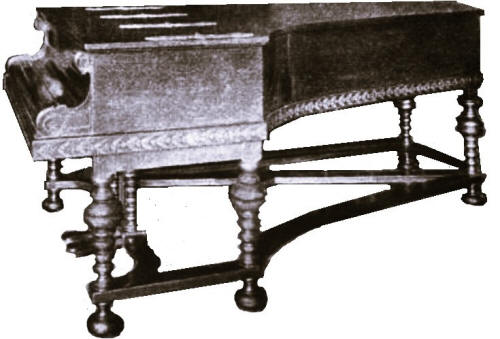
The disposition of the strings, internally, being more like that of the harp than in the generality of pianos, the outline is more graceful and less bulky than that of most modern grands. But the chief feature is as follows : - Instead of the usual legs, Mr. Henschel substitutes six massive Jacobian columns. They are not spiral, but are turned ball upon ball, the ball or ellipse, which is situated two-thirds of the way up the leg, being twice the size of its neighbours; thus forming, as it were, a capital to each column. These columns, further, are connected together by horizontal stretchers or beams.

The latter ingeniously follow the outline of the piano itself, and are intersected by two other beams meeting under the middle of the body of the instrument in the form of a St. Andrew's cross, the lower arms of which-i.e., those nearest the pedals are curved outwards.

In regard to the pedals, Mr. Henschel makes another departure from custom, by dispensing with the conventional lyre-ornament. He prefers to allow the pedal-rods to work between two columns, turned in the same ball-upon-ball fashion as are the massive legs. The castors, attached to the legs so as to render it easy to move the piano about, are effectually hidden by means of large ellipsoidal bases, which impart an appearance of great strength, in keeping with the weight of the modern iron, or steel, grand.

As to the polish, a charming effect has been gained by toning down the oak of this piano by means of fumigation, so that it harmonises with the rich wainscot panelling of the music room at Bedford Gardens, Kensington, which the piano has been intended to adorn. Appropriately surrounded as it there is, the general effect of this newly-designed piano is stately, and singularly agreeable. "That is the best part of beauty," says Bacon, "which a picture cannot express."

In regard, therefore, to the musical soul enshrined in this exceptional case, it is impossible to say more than that the mechanism embodies the latest improvements and patents of the Broadwood firm, and that the distinguished purchaser expresses himself in high terms of both the tone and touch.

On Saturday evening Mr. Henschel invited a few of his musical friends to see and hear his new piano, as it forms a part of his now famous music room, and all united in their admiration of its beautiful and original appearance and its rich luscious tone." The Musical Courier, 21/11/1895, p. 28

MR. HENSCHEL’S NEW PIANO.

"The Pianoforte illustrated above has been made by Messrs. Broadwood for Mr. Henschel, the eminent singer, musician, and conductor, under his directions and after his own sketches.

As will be observed, he has given another new suggestion in the treatment of the legs of the piano. The case is a comparatively simple one in regard to decorative treatment ; it is in solid oak, merely relieved by a floral ornament incised in a band round the lower margin of the case, and a little carved scroll-work at the extremities of the keyboard.

The hinges of the lid are ornamental and of wrought-iron. We very much question the advisability of the introduction of these large metal hinges on the case of a piano. All metal, except that which is necessarily used in the internal construction, is better away. The slightest working loose of these hinges in process of time would lead to jarring." The Builder, 16/11/1895, p. 85

more about Henschel's pianoforte

"Messrs. Broadwood & Co. have just completed another triumph of artistic design in pianoforte manufacture, for Mr. Henschel. It is not generally known that this versatile musician is also a clever draughtsman, and possesses a delicate taste in matters artistic.

The shape and bulk of a grand piano have long been the despair of those who desire to have nothing in their drawing-rooms or studios to offend the eye, and many have at different times endeavoured to modify the design, or to decorate it in some way which may improve the general effect.

Sir E. Burne Jones has imitated, instead of the ugly three legs, the old tressels upon which harpsichords were once made to stand. Mr. Alma Tadema, on the other hand, has replaced the legs by massive columns and twin pillars, Byzantine in style.

The chief feature in Mr. Henschel's new design is the substitution of six Jacobean columns for the usual legs; and, in regard to the pedals, Mr. Henschel makes another departure. He has discarded the usual lyre-shape support, and has arranged for the pedal rods to work between two columns, turned in the same fashion as the massive legs.

As regards decoration, there is no over-elaboration in this instrument. The case is of solid oak, and is relieved by some simple floral work of classic design; and the external shape of the instrument approaches more nearly to that of the harp than the ordinary grand piano, the usual curve being considerably modified.

This fine new instrument has taken about 12 months to construct, and reflects credit alike on the makers and on the accomplished designer of the case. Musicians will await with interest information as to Mr. Henschel's next accomplishment." Musical News, 23/11/1895, p. 431

more about Henschel's pianoforte; and pianists

"A good deal has been written of late concerning the want of symmetry in the outline of the conventional grand pianoforte. The unequal look imparted to the instrument by the inevitable curve on the treble side, due to the shorter strings required for the higher notes, has especially been deemed inelegant.

How to retain this one-sided curve and yet make an artistic looking instrument, has long been a problem for the pianoforte maker. Different methods of dealing with the supports of the case have been tried. For the conventional legs Sir Edward Burne-Jones has ingeniously substituted a stand somewhat after the pattern of the old trestles with which the harpsichord was provided.

On the other hand, Mr. Alma Tadema has replaced the single legs by massive columns and twinpillars, Byzantine in style. Now we have legs of different character still, designed by Mr. George Henschel, whose versatility is the wonder of his friends and the English musical public generally. Mr. Henschel substitutes six massive Jacobian columns for the usual legs.

Those columns are not spiral, but are turned ball upon ball, the ball or ellipse, which is situated two-thirds of the way up the leg, being twice the size of its neighbors, thus forming, as it were, a capital to each column.

These columns, further, are connected together by horizontal stretchers or beams. The latter ingeniously follow the outline of the piano itself, and are intersected by other beams meeting under the middle of the body of the instrument in the form of a St. Andrews Cross, the lower arms of which, i. e., those nearest the pedals, are curved upwards.

In regard to the pedals, too, Mr. Henschel made a departure from custom by dispensing with the usual lyre-ornament. He prefers to allow the pedal rods to work between two columns turned in the same ball upon ball fashion as the legs.

Again, the castors attached to the legs are effectually hidden by means of large ellipsoidal bases, which impart an appearance of great strength in keeping with the weight of the modern iron or steel piano.

The case is of solid oak which has been toned down by fumigation so as to harmonize with the rich wainscot panneling of Mr. Henschel's music room. It is relieved simply by some floral work of classical design, incised in a band round the plinth of the case, and by some delicately carved scroll work on the cheeks at either extremity of the keyboard.

Four antique-looking strap hinges, of wrought iron, give a quaint finish to the top, inside of which the music desk and candle board, medioeval in style are in keeping. The disposition of the strings internally being more like that of the harp than in the generality of pianos, the outline is more graceful than that of most modern grands. The instrument, it may just be added, has been made at Messrs Broadwood's manufactory at Westminster.

<<< >>>

Speaking of Messrs Broadwood, a very interesting little book bearing the title of "Information Concerning Pianofortes," has just reached me from that historic house. Looking it through, one comes upon many curious items of information regarding the history of the household instrument.

Now the concert grands are made with a compass of 7 octaves, it seems strange to read of grands with the "extended" compass of 5 octaves. Yet a memorandum of John Broadwood dated 13th of November, 1793, says: "We have made some 5 octave grands these three years past, the first to please Dussek, which being liked, Cramer junior had one."

From 5 to 7 octaves the extension has been very gradual, and to certain pianists the "additional keys" have been a source of worry for more than a century, as the following entry in one of Messrs Broadwood's books shows: "May 23, 1793, making a box to cover the additional keys." This was a contrivance to hide the top half octave so as to prevent inconvenience to the player unaccustomed to the sight of the extra notes.

The pianoforte was invented, as we know, by an Italian named Cristofori, in 1709. From an old play-bill in Messrs. Broadwood's possession it was not, however, until 1769 that the instrument made a public appearance in England. It was then announced that "Miss Brickler will sing a favorite song from Judith, accompanied by Mr. Dibdin on a new instrument called pianoforte "

The Mr. Dibdin here mentioned was of course the tuneful Charles who sang of Tom Bowling and other naval worthies. Twenty years later the modern instrument began to supersede its precursor, the harpsichord. From a porter's book at Broadwood's we find that on the 28th of March, 1786, "Mr. Jackson, of Exeter, ordered a grand pianoforte for his own use in exchange for a harpsichord." And what the composer of the now heavy "Jackson in F" did, others no doubt did too.

The Broadwood business is now being conducted by the sixth generation in succession, and in the very house where it first began in 1732, the year of Haydn's death. The premises possess many interesting associations. Here Mozart, Sr., with his little son Wolfgang, called to rehearse on the harpsichord made for Frederick the Great and now in the Royal Palace at Potsdam. Here Haydn wrote a portion of one of his compositions when he had a temporary lodging in the same street.

Here Chopin gave his last recital in England, when he was so feeble that he had to be carried up stairs. Mr. A. J. Hipkins, of Broadwood's, thus describes the composer's appearance: "He was about middle height, with a pleasant face, a mass of fair curly hair like an angel, and agreeable manners. But he was something of a dandy, who always wore patent leather boots and light kid gloves and was very particular about the cut and color of his clothes. Hecame here (to Broadwood's) very frequently and his playing and his compositions, then almost unknown, fascinated me."

In 1818, Mr. Thomas Broadwood sent a piano to Beethoven as a present, which the great composer acknowledged in ungrammatical French, but with much warmth of expression, concluding his letter with, "My dear sirand friend, receive my greatest consideration, from your friend and very humble servant, Louis van Beethoven."

We are told that nobody except Stumpf, Beethoven's tuner, was ever allowed to touch the instrument, to which an acoustic contrivance was attached enabling the composer to hear its sound after he had become so deaf that otherwise the volumes of music floating through his brain could not return to him when called forth from the keys. This pianoforte is now in the National Museum, Budapest, after having been in the possession of Liszt." Music: Devoted to the Art, Science, Technic and Literature of Music, Volume 9, 1895, p. 419-421

1896

more about Henschel's pianoforte

"Messrs. BROADWOOD have doubtless produced more ornate examples of their work than the piano reproduced on p. 119; but this is of interest from the fact that it was designed by its owner, Mr. G. HENSCHEL.

The case is made of solid oak, relieved only by an incised band of floral work round the plinth, and by some delicately executed carved scrollwork on the cheeks at the extremities of the keyboard.

The hinges are of wrought iron, designed after antique models. The chief feature of the design is the substitution of six massive Jacobean columns for the usual legs. They are turned ball upon ball, the ball situated twothirds up the column being twice the size of its neighbours.

The columns are connected by horizontal beams ingeniously following the outline of the piano, being intersected by two other beams meeting in the middle in the form of a St. Andrew's cross.

Instead of the usual lyre-ornament for the pedals, the wires work between two small columns of the same pattern as the legs. The oak has been toned down by fumigation, so as to harmonise with the wainscot panelling of Mr. Herschel's music-room, where the piano stands." The Magazine of Art, Volume 19, 01/1896, p. 119

Upright pianoforte
 designed by H. B. SCOTT
,
 exhibited by the Arts and Crafts exhibition

"The other, designed by Mr. H. B. Scott for Messrs. Broadwood, is something quite new in upright piano cases.

It has the appearance of a plain solid-looking square cabinet on high legs, with folding doors in front, which hide the projection of the keyboard entirely; when the instrument is to be used these are opened and the hinged top lifted.

As a matter of principle we should say that the usual method of making the projection of the keyboard a feature in the external design is quite correct; the doors in this instance only enclose an empty space bahind them when closed; but some people may prefer this mask to the form of the instrument, and at all events it is a piece of excellent and solid cabinet-maker's work, with no nonsense about it.

The candle-brackets which are seen at the sides, when the doors are opened, though very prettily designed, are however wrongly placed; they would be found to be both too low down and too near the plane of the book-desk to be of much practical use." The Builder, Volume 71, 17/10/1896, p. 304

1897

"Mr. Baillie Scott has succeeded in disguising the form of the instrument most successfully, and has produced a satisfactory form by enclosing the whole thing, from the Key-board upward, by means of doors, and making the top of the piano wide enough to meet these doors. The case is of green stained oak, and is furnished with good hinges reaching almost across the doors, and lock plate and handle, all of which are in copper. When the doors are open, they can be thrown right back out of the way of the performer; and the inside is furnished with the necessary music rest and candlesticks; the latter of good design in steel and copper. This is by far the best idea that has yet been reached for a cottage piano." - The Artist."

Advertisement with an upright pianoforte, designed by M. H. Baillie Scott,
'The Manxmann' in Musical News, Volume 13, 03/07/1897, p. 2

THE CHOICE OF SIMPLE FURNITURE

COTTAGE PIANO
DESIGNED BY M. H. BAILLIE SCOTT

"Amongst the drawing-room furniture which is illustrated in this article mention must be made first of the cottage piano on this page which has been carried out by Messrs. Broadwood.

This represents an attempt to realise something more artistic than the ordinary type of case, in which the keyboard projects as an excrescence from the main body of the piano. It was felt that in order to obtain a satisfactory result the keyboard should be incorporated in the case, and with this object the sides and top of the piano have been extended to the front line of the keyboard.

The removal of the candles to a position where they will light the music without dazzling the eyes of the player, and the substitution of a long shelf with sloping back for the usual inadequate music rack, are both practical improvements on the ordinary type of piano, while the projecting sides and top act as sounding boards, and so immensely improve the acoustic properties of the instrument. This case has been carried out in oak, stained a dark rich green, with hinges in white metal.

The essential novelty is, however, the form of the case, which would lend itself readily to many kinds of decorative treatment. The cabinet on page 154 may be finished in the green and silver scheme which has been mentioned for the piano." The Studio, Volume 10, 1897, p. 154

1898

DEATH OF A BROADWOOD AT FOURSCORE YEARS.

Bohm and the Broadwood Grand Scales.

"Mr. Walter Stewart Broadwood, who died in his 80th year, was a descendant of Mr. John Broadwood, founder of the famous pianoforte house, and was at one time a partner of the firm. He was best known as a student of the flute, and was a great friend and admirer of Theobald Boehm, originator of the system of fingering, which, although devised in 1831, is still in use in a modified form.

Mr. Broadwood translated Boehm's book on flutes, which is still considered the standard work on the subject. It is interesting to note that when the claim for the new fingering was made for a certain Captain Gordon, Mr. Walter Broadwood declared that he had known Theobald Boehm intimately for forty years, and not only was he convinced of Boehm's claim to the invention of the flute, which bears his name, but also that Messrs. Broadwood and Sons «had repeatedly and ungrudgingly acknowledged the assistance afforded them years ago by Boehm when calculating the scale of grand pianos.»" Watson's Weekly Art Journal, Volumes 72-73, 17/12/1898, p. 169

1899

The Pianoforte Trade and the Pitch Question.

"TO THE EDITOR OF "MUSICAL NEWS."
33, Great Pulteney Street, London, W.,
3rd July, 1899.

SIR,
THE desirability of the adoption of a uniform musical pitch in this country has long occupied the attention of musicians and makers of musical instruments, but it has never before been discussed so much as it is being at the present time.

When the Philharmonic Society in London a few years ago decided to lower its orchestra to what was, to all intents and purposes, the Continental pitch, that decision led to considerable confusion.

Sufficient time has, however, now passed to show the desirability of the new Philharmonic pitch being generally adopted. Organs in many halls and churches have been lowered at considerable expense, and all the best wind orchestral players are now provided with instruments at both pitches.

So far, pianoforte makers have held aloof and made no united effort to secure uniformity in regard to to the pitch at which their productions are tuned. Some favour one pitch and some another.

The consequence is that if a visit be made to any of the large emporiums in provincial towns where many pianos are sold, the visitor is hampered in his chcice by seldom finding all pianos in the same show room tuned to a uniform pitch, as they would be in a similar warehouse on the Continent.

If an occasional pianoforte dealer decides to keep all the instruments he has in stock at a uniform pitch, the result is not always satisfactory. A piano, carefully tuned to the low pitch before being sent to him, may be raised, or a high pitch piano lowered, and the instrument given a different tension from what the manufacturer intended, not that the raising or lowering of pitch injures any piano, but, if the alteration is made, the piano requires usually more than one careful tuning to make it stand.

In regard to concert grands, the want of uniformity in regard to pitch is serious, and necessitates makers keeping a double number of those instruments.

There are other reasons which could be given to show why the vexed question of pitch should be definitely settled in the pianoforte trade.

Had any of our neighbours moved in this matter, we should have gladly supported the object in view. As it was necessary, however, for someone to take the initiative we addressed the following letter, last week, to the leading firms in our trade :

"You are aware that the pitch for pianofortes in Great Britain has been a vexed question for the past few years, causing pianoforte manufacturers a great deal of trouble and inconvenience.

"We feel sure you will agree with us that the time has now come for the leading pianoforte manufacturers to settle once and for all what pitch shall be adopted in Great Britain as the standard pitch for pianofortes, both for retail and wholesale purposes.

"We, for our part, are confident that the pitch for pianofortes should now be A = 439 Diapason Normal at 68° F., that being the pitch now adopted by the Philharmonic Society, the Queen's Hall Orchestra, and the leading musical institutions in London, and by almost all our leading musicians.

"In such an important matter is this, it is of the utmost consequence that the leading pianoforte manufacturers should be entirely unanimous, and take a firm stand.

"It is proposed that this pitch (A = 439) be adopted as the standard by pianoforte manufacturers on and after September 1st, and that C = 540 (A = 454), the late Philharmonic pitch, shall then be regarded as the exception and not the rule, as is now the case.

May we ask you to favour us with your careful consideration in this matter, and to oblige us with a reply stating your decision at your convenience"?

The replies received have almost all expressed approval of the suggestion. We should like to quote the letters in full, but, as this would encroach too much on your valuable space, the following brief extracts may suffice :

Mr. Lindlar, on behalf of the house of Bechstein, writes :

"I quite agree with you that the confusion now reigning as regards pitch should be settled in some definite way if possible." Mr. Whelpdale, on behalf of Messrs. Blüthner, writes : -

"We hasten to inform you that for the past 12 months we have sent out all our pianofortes at the new Philharmonic pitch, and we have experienced no difficulty whatever with either the public or the trade." Messrs. John Brinsmead and Sons write : -

"We shall be glad to welcome the Continental pitch as soon as possible...,; but must await the decision of our trade customers.' Messrs. Chappell & Co., who are military instrument makers as well as pianoforte manufacturers, are at present unable to make the alterations suggested.

In a personal interview, Mr. John Collard, of Messrs. Collard and Collard, said that his house had long tuned all pianofortes to their own "medium" pitch, but he would have a couple of instruments lowered experimentally, and, if the rest of the trade decided, his firm would willingly "come into line."

Messrs. Challen and Son reply : -

"We entirely agree The present unsettled state of the question is a frequent source of trouble and inconvenience to us."

Messrs. S. and P. Erard write :

"No one will be better pleased to see the vexed question of the pitch for pianofortes settled than we ourselves, and we shall have very much pleasure in supporting you in your efforts towards that end in every possible way."

Mr. John Hopkinson, on behalf of Messrs. J. and J. Hopkinson, writes :

"We do not wish to stand out... if the low pitch is generally approved by pianoforte manufacturers."

Messrs. George Rogers and Sons write : -

"We are quite ready to take part in this movement, directly the unanimous co-operation of the leading makers is secured."

Perhaps, however, the most interesting letter is that from Mr. Eshelby, of Messrs. Steinway and Sons, who expresses his firm's perfect willing to co-operate in the matter, but suggests that a Society might be instituted to further the adoption of a uniform pitch, and raise money to assist bands to replace their present instruments, and also to aid in lowering the pitch of large organs.

The opinions of two of the largest pianoforte distributing firms should here be added. Messrs. Forsyth Bros., of Manchester, write: -

"We quite agree that the time has arrived for the standard pitch for pianofortes to be settled once and for all. We are convinced that it will be for everybody's benefit if this change be made."

Messrs. Paterson, Sons & Co., of Glasgow, cordially agree, and add : -

"May we suggest that you carry with you the principal American organ manufacturers"?

We are, Sir,

Your obedient Servants, JOHN BROADWOOD AND SONS." Musical  News, 08/07/1899, p. 36

1901

Broadwood's grand pianoforte
 designed by E. L. Luytens

"At their show-rooms in Great Pulteney Street, Messrs. Broadwood are inviting public attention during the present week to the collection of pianofortes that so worthily upheld the reputation of the firm at the Paris Exhibition.

A notably fine specimen is that designed by Mr. E. L. Lutyens, which, exhibited in the Royal Pavilion, was awarded the Grand Prix. Jacobean in style, this instrument is supported by no less than sixteen legs, and among the noted pianists whose fingers sought its keys during its sojourn abroad was Mr. Paderewski.

Grand piano in Georgian style
 designed by Arthur Blomfield

Close by is a concert grand more massive in appearance than the instrument just mentioned. This pianoforte, designed by Mr. Arthur Blomfield, is in the Georgian style, and has a handsome case of Spanish mahogany.

Mr. Charles Allom has furnished designs for two semigrands, one of these instruments having a satinwood case which is beautifully inlaid with engraved marquetry, while the other in the style of Louis XVI., is richly carved.

A novelty, though already it seems to be in good request, is the upright grand, cased in oak, and known as "The Manxman." For the shape of this instrument an old treasure chest of the time of Queen Elizabeth served as model.

Several handsome specimens are shown. Early Flemish in style, and very solid in appearance, is the pianoforte designed by that many-sided musician, Mr. Georg Henschel, for his own use.

Visitors to Messrs. Broadwood's establishment will be much interested in a recent arrival from Sandringham. This is nothing less than the grand pianoforte made for Queen Alexandra soon after her marriage, and only quite recently exchanged for the first specimen of the firm's instruments with steel barless open frame." The Violin times, ed. by E. Polonaski and E.H. Allen, Volumes 7-8, 15/03/1901, p. 65

The Piano aesthetically considered by Hugh B. Philpott

Grand piano of Broadwood,
designed by Burne-Jones and Edward Coley,
decorated by Kate Faulkner,
made in 1883,
Victoria & Albert Museum, South Kensington, London

[...][...] In a piano, designed by Sir Edward Burne Jones and made by Messrs. Broadwood and Sons for the Ameer of Afghanistan, a very beautiful effect has been obtained without any considerable departure from the wutomary form. It is in oak with gesso decoration, the latter the work of Miss Kate Faulkner.


Top of a grand piano,
designed by William Morris

The Artist: An Illustrated Monthly Record of Arts, Crafts and ...,
Volumes 31-32, 1901
, p.
187

In a less regal style, but nomeans less beautiful, was a piano designed by the late William Morris and also carried out by Messrs. Broadwood. We illustrate on page 187 [here above] the most characteristic part of the design, marquetery on the piano top.

What a splendid vigour there is in this bold and simple design, and how admirably it fills the space; one almost forgets in contemplating it the awkward shape of the surface that had to be covered, with such aparent ease does the designer attain his end.

Between the art ideals of William Morris and those of the french artists and craftsmen of the time of Louis XV. there is a great gukf fixed. To admire the one almost implies some lack of appreciation, if not a positive dislike for the other.

But wharever one may think of the 'Louis' styles they have been held in high favour for a very long time, and their popularity does not seem to be greatly declining; nor are they likely to do so among those - a not considerable band - who love brilliancy and display, and delight in giving an impression of great wealth.

It was inevitable, then, that ever since the decoration of the cases began to recieve the attention of pianoforte makers, many of the most expensive instruments should be produced in these French styles.

Concert grand piano in Spanish Mahogany,
 inlaid with coloured woods,
designed by Arthur C. Blomfield, F.R.I.B.A.;
manufactured by John Broadwood & Sons

The Artist: An Illustrated Monthly Record of Arts, Crafts and ...,
Volumes 31-32, 1901
, p.
183

[...][...] Want of originality cannot be urged against the striking example of a concert grand designed in the Georgian style by Mr. Arthur C. Blomfield, the eminent architect (page 183) [see here above].

It will be noticed that at each end of the instrument it is supported by two pairs of legs connected by stretchers-a great improvement on the three clumsy legs which, at first adapted for practical convenience, have come to be regarded by most makers as the inevitable and unalterable means of support for a grand piano.

The practical disadvantage of having six or more legs instead of three is that if the floor is not quite level, an unpleasant jarring may result from one or two of the legs not touching the floor. But as a wedge or two of paper will remedy the defect, if it exists, this hardly seems an adequate reason for perpetuating an inartistic form. Mr. Blomfield's design is carried out in Spanish mahogany beautifully inlaid with lighter woods; round the sides and inside the cover appropriate mottoes are inlaid.

Drawing room grand piano in oak,
 designed by E. L. Luytnes;
manufactured by John Broadwood & Sons

The Artist: An Illustrated Monthly Record of Arts, Crafts and ...,
Volumes 31-32, 1901
, p.
181

The advent of some of our more artistic architects in the field of pianoforte designing has certainly been followed by excellent results. Mr. E. L. Lutyens, for instance, has produced a very successful design which again is a decided departure from the conventional form (page 181) [see above].

The style is Jacobean, and perhaps the most original feature of the design is the fact that there is no curve in the sides, the usual curved part being replaced by straight pieces joined at a very obtuse angle.

Contrasting pleasantly with the straight sides are the curved stretchers connecting the legs. By increasing the number of legs (there are thirteen in all) it is possible to employ quite slender ones, and so get an appearance of lightness without loss of stability.

A good feature is the way in which the keyboard is directly supported by the legs instead of projecting like an excrescence from the body of the instrument in the usual way. The treatment of the pedals is worthy of notice; the conventional lyre with its three bars, one of which generally has no functional purpose to fulfil, is dispensed with, and the two upright steel rods that control
the action are frankly exposed to view.

The piano has been carried out in unpolished oak; the music desk and candle boards are of hammered iron. This particular piano was exhibited by Messrs. Broadwood at the Paris Exhibition, and was awarded the Grand Prix, though, of course, the award was a recognition rather of the musical qualities of the instrument than of the design of the case.

The point is worth noting by any who are disposed to fear that attention to the æsthetic side of piano making may tend to the neglect of its essential qualities as a musical instrument. Here is a piano which the highest authorities declare to be a musical instrument of supreme excellence, and which is, at the same time, a singularly tasteful and original piece of designing.

The fact that Messrs. Broadwood have shown themselves able and willing to produce instruments that will not only be musically satisfactory but will meet the artistic wishes of their clients, has led many people of eminence in the artistic world to entrust to them the production of pianos of special designs.

Grand piano in oak with ebony, ivory, tortoise-shell, lapis lazuli and mother-of-pearl decoration;designed in Byzantine style; by Sir Lawrence Alma Tadema, manufactured by John Broadwood & Sons
The Artist: An Illustrated Monthly Record of Arts, Crafts and ...,
Volumes 31-32, 1901
, p.
182

One of the most interesting examples the firm has carried out is the piano designed by Sir Laurence Alma-Tadema for his own house (page 182) [see here above]. The design is quite Byzantine in feeling, and the owner must have lavished upon it 'the wealth of Ormuz and of Ind.'

The top is inlaid with ebony, ivory, tortoiseshell, mother-of-pearl and lapis lazuli; at each end of the keyboard is an elephant's tusk of enormous size, richly carved; the small end of the piano is occupied by a beautiful panel in repoussé silver, and the music desk is of brass in wich the monogram 'A.T.' is ingeniously wrought.

The top is covered inside with vellum, and the value of the instrument will be enhanced by the collection of autographs - already including Wagner, Liszt, and many other famous names - of musicians who have played on it. The piano is not complete without its seat which takes the form of a double throne of cedar and ivory beautifully painted and covered on the top with fine brocade.

All this magnificence, of course, means that this instrument is interesting as a unique example, rather than as a type.

  Table piano in oak, inlaid with coloured woods;
designed by Charles Robert Ashbee,
manufactured by John Broadwood & Sons
The Artist: An Illustrated Monthly Record of Arts, Crafts and ...,
Volumes 31-32, 1901
, p.
186

More possible for ordinary folks, and at the same time widely removed from the conventional, is such a piano as that designed by C. R. Ashbee, and illustrated on this page. Mr. Ashbee discards altogether the nondescript shape which most people have hitherto considered inevitable in a grand piano, and boldly adopts a rectangular form.

This, no doubt, greatly simplifies the decorative problem, but how, it will be asked, does it affect the piano as a musical instrument? So far from there being any loss of efficiency, there is said to be a distinct gain from the adoption of this form.

It is not within the scope of this article to enter into questions of mechanical construction, but generally, it may be said, that the construction employed by Messrs. Broadwood, who have carried out Mr. Ashbee's design, enables them to take advantage of the extra space gained by adopting the rectangular form, so that they get an additional expanse of sounding board and a stronger frame.

The result of this is that with a rectangular piano of the size known as 'semi-grand' they are able to get a fulness of tone equal to that obtained from a concert grand of the ordinary make. They have now made a number of these pianos, and in every case the result is stated to have been thoroughly satisfactory in musical sense.

Mr. Ashbee's piano gains greatly in appearance from the striking and beautiful colour scheme he has adopted in the decoration, but to this, of course, it is impossible to do justice in a black and white illustration.

So far I have spoken only of the grand piano, but few will deny that in the case of the upright or 'cottage' variety there is at least equal need for an artistic renaissance. It is indeed surprising that among the millions of cottage pianos that have been made since the instrument first came into vogue so very few have shown the slightest tendency to depart from the one stereotyped form with which we are so painfully familiar.

Seeing the same shape reproduced again and again, we have come to regard it as the only possible one; and while artistic people have been almost prepared to accept the ugliness of the cottage piano as a dispensation of Providence to be endured with what grace they may, the inartistic multitude have taken pleasure in fretted and inlaid fronts and carved legs, and have been inclined to resent as something monstrous and unnatural the essays of the few daring innovators who sought to point a way out of the artistic morass in which the bulk of pianoforte manufacturers are still deeply sunk.

Both in the grand and the upright piano, but more especially in the latter, it is the keyboard that is the great difficulty from the designer's point of view, and one thing to be accomplished by everyone who seeks to invent a more artistic form of piano, is to find some way of making the keyboard less like an excrescence and more like an essential part of the construction.

See an upright pianoforte
 designed by Baillie Scott,
 manufactured by Broadwood & Sons
 in V&A Kensington Museum, London

Prominent among the artistic designers who have tackled the knotty problem of the cottage piano to some purpose, is Mr. H. Baillie Scott. The model which Mr. Baillie Scott has introduced is of so revolutionary a type that it is to be feared it will be a considerable time before it achieves popularity. Yet it is conceived on thoroughly sound artistic lines. The design is based on the model of an Elizabethan strong box.

The top and sides of the piano are brought forward to the level of the keyboard, the upper part is enclosed within doors, which Mr. Scott decorates with strap hinges, and the whole of the upper part is supported on a substantial framework. A smaller innovation, but a very useful one, is in the arrangement for supporting the music.

Mr. Scott dispenses with the usual flimsy music rack, and replaces it by a shelf with a sloping back, which extends the whole length of the keyboard, thus allowing plenty of room for any reasonable quantity of music. The space between this shelf and the keyboard is occupied by silk panels, a feature once almost universal but now generally discarded, which Mr. Scott has re-introduced.

Upright piano in oak,
designed by Gilbert Oglivy,
manufactured by John Broadwood & Sons
The Artist: An Illustrated Monthly Record of Arts, Crafts and ...,
Volumes 31-32, 1901
, p.
189

Our illustration on page 189 [see here above] shows a slight development of this type of piano, which has been designed by Mr. Gilbert Oglivy, and carried out in oak by Messrs. Broadwood. The doors, it will be seen, are hinged, the strap hinges being made a decidedly decorative feature.

The supporting legs are doubled and united by stretchers, the lower panels are decorated by carving, and the inside of the doors, sides and top are beautifully inlaid with mother-of-pearl and coloured woods. Altogether the design, while following the lines first laid down by Mr. Baillie Scott, is somewhat lighter and more ornate.

Again we find that the radical change of form enhances rather than detracts from the musical quality of the instrument. The doors and the projecting top act as additional sounding boards, giving a rich and powerful tone not otherwise obtainable in an upright piano."
The Artist: An Illustrated Monthly Record of Arts, Crafts and ..., Volumes 31-32, 1901, p. 181-189

«The Manxman», Semi-Grand : in solid Oak Case
 with keyboard enclosed by doors,
 corners with strap hinges of hammered iron.
Mounted on a Harsichord Stand.

(on an advertisement  in 'The Connoisseur' of 1902)

Pianoforte made in style of Louis XV,
 with richly carved and gilt case.

Look also to a PLEYEL model same period (1905)
(on an advertisement in 'The Connoisseur' of 1903)

Upright pianoforte, in spanish Mahogany case
with black and white inlays.
The double doors are fitted with iron hinges
 pierced and mounted upon vellum. The interior lined troughout with holly.
Designed by C. R. Ashbee,
under whose supervision the hammerd ironwork
 was made by the Guild of Handicraft.
(on an advertisement in 'The Connoisseur' of 1903)

1903

about the piano designed by Mr. Ashbee

The Arts and Crafts Exhibition

"The piano is rather maltreated in this exhibition. Standing on the floor of the Central Hall is an object which if we had not already seen it elsewhere, we should have taken for a large wooden cistern on bearers.

This is the grand piano designed by Mr. Ashbee for Messrs. Broadwood; an immense square mass, rounded at the angles with coarse-looking metal hinges and other work; really about as ugly and unwieldy an object, and as little suggesting a musical instrument, as could well be.

It is unpractical too, for the method of opening, with swing-doors opening as folding-doors, is inconvenient and likely to be annoying to the player. The old-fashioned folding-back lid, which disappears and leaves the keyboard quite open and unimpeded, is ever so much better in a practical sense.

The supports are well designed that is the best part of it; and there are some pretty decorative paintings on the front and the inside of the lid; butas for the general appearance, we would rather have the old stereotyped form of grand piano (decanter-stopper legs and all) as an inmate of a drawing-room; for its general form at least was characterised and more graceful than this immense square box." The Builder, Volume 84, 17/01/1903, p. 57

BROADWOOD
on this site


EXPOSITIONS
FACTORY
PIANO CONTROVERSY, 1851
FIRE
ARTICLES
BIOGRAPHY

Click on the links above.

For more information and references see page
alfabetic B


 © Copyright all rights reserved


rt